
spread betting in new zealand: what is on offer, and who may legally offer it
 Available in US
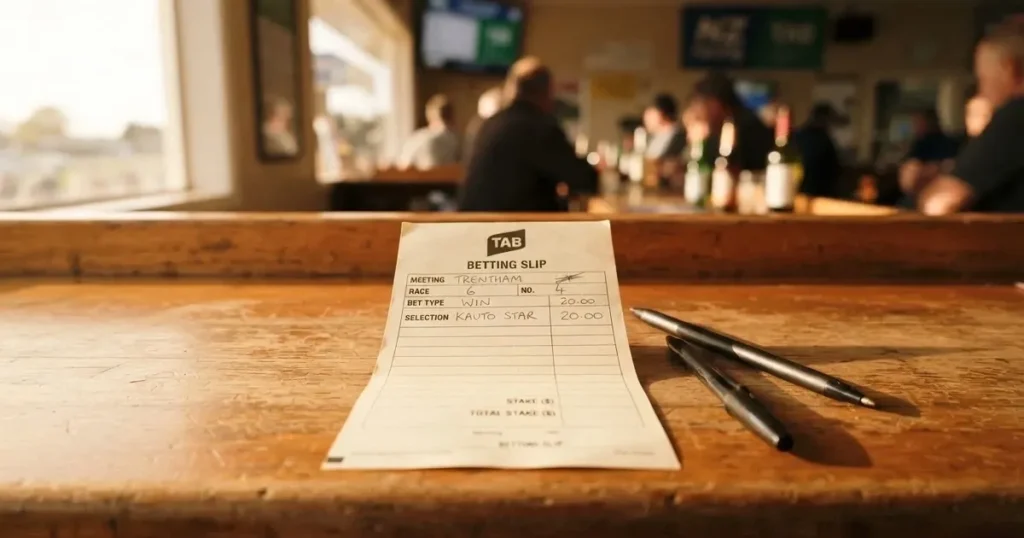
A punter in New Zealand searching for spread betting hits a wall almost immediately, because the activity they are asking about is, in the form it takes in London or Sydney, not on offer from any New Zealand-licensed operator. The only provider lawfully taking sports and racing bets from people in New Zealand is TAB NZ, and TAB NZ’s published sports-betting definition does not extend to spread betting. This page sets out what spread betting actually is, how it differs from the fixed-odds and tote betting that TAB NZ does offer, where the law now stands, and how the two TAB NZ brands compare for a reader who wants to bet on sport in New Zealand in 2026.
Current as of October 30, 2026, verified against the Department of Internal Affairs public register and the TAB NZ and Betcha app-store listings.
Staying in control while betting in New Zealand
Responsible gambling sits at the top of the page deliberately, because in New Zealand the conversation about betting is also a conversation about harm minimisation, and TAB NZ — the only lawful operator — runs under a statutory duty to minimise the risks of problem and underage gambling. Any reader who is here to compare brands first and to think about limits later is reading the page the wrong way around.

The framework starts with age. Betting under 18 is an offence under section 89 of the Racing Industry Act 2020; land-based casinos in New Zealand have a higher age threshold of 20, and the betting age does not lift to match them. A punter who sets up a TAB NZ account will be asked for a verified New Zealand address and identification before deposits clear, and the same check applies to Betcha, because both brands sit behind the same TAB New Zealand holding company and the same harm-minimisation rules.
TAB NZ provides the safer-gambling tools a punter expects. The TAB app supports deposit limits, time-outs, and self-exclusion, and an exclusion entered through either TAB or Betcha applies across both brands because they are operated as a single account ecosystem. The free Gambling Helpline — 0800 654 655, with the text line at 8006 — sits in the app alongside those tools. Outside the app, Safer Gambling Aotearoa is the public-facing service most readers in New Zealand meet first. The Problem Gambling Levy funds that work: TAB NZ pays 0.74 per cent under the current three-year cycle (1 July 2025 to 30 June 2028), with the rate set by the sector rather than by individual operators.
The bettor-side reality of these tools matters as much as their existence. A deposit limit set today only blocks the next deposit; it does not reverse what has already gone in. A time-out runs for a window the punter chooses; a self-exclusion is the heavier tool and is the one a punter who has been chasing losses needs to pick up the phone about. None of this is a substitute for the helpline if the betting has stopped being fun.
A note on what the New Zealand system does not provide: there is no single national online-betting exclusion register for sports and racing. The register that the Online Casino Gambling Act 2026 will introduce covers online casinos only, and betting exchanges and spread-betting firms are not part of it. A punter who self-excludes from TAB NZ removes themselves from TAB and Betcha; they remove themselves from nothing offshore.
For a reader who has decided to step back from betting altogether, the order of operations is straightforward. Set the deposit limit to $0 in the TAB or Betcha account, raise a self-exclusion through the same app, speak to the Gambling Helpline on 0800 654 655 or text 8006, and tell a household member what is being done so the self-exclusion is harder to walk back. The mechanism is light; the resolve behind it has to be the punter’s own.
Spread betting, fixed-odds betting, and the tote: how the three pay out
The vocabulary in this market is older than most of the operators using it. Spread betting as a wagering form was invented by Charles K. McNeil, a Connecticut mathematics teacher who became a Chicago bookmaker in the 1940s, and it has carried two distinct meanings ever since. In North American usage the “point spread” is a handicap that turns a moneyline into an either-or bet at roughly even money, with a push (a result landing exactly on the spread) returning the stake. The standard price on that side of the Atlantic is 10 to 11, also written -110, meaning a punter wagers $11 to win $10. In UK and financial usage, “spread betting” is something else entirely: the bookmaker quotes a spread such as 340–350, the punter buys at the top or sells at the bottom, and the profit or loss is the stake multiplied by the number of points the result differs from the bet level. Losses on that side are not capped by the stake.

A worked cricket example shows the shape of the bet. With a spread of 340–350 runs, a punter who takes the buy at 350 has the team scored at 400 as the winning scenario: 50 points of difference, 50 units times the stake as the profit. The same bet at 300 runs is the losing scenario: 50 points of difference the other way, 50 units times the stake as the loss. There is no ceiling on the loss beyond the punter’s margin with the bookmaker. In financial spread betting the collateral is typically 5 to 10 per cent of total exposure, which is the practical cap, and that ratio is the reason a small stake can move into a large liability.
The New Zealand punter sits closer to the fixed-odds and tote end of the spectrum. TAB NZ publishes a defined list of bet types — Win, Place, Each Way, Quinella, Exacta, Trifecta, First Four, Double, Treble, Daily Double, Running Double, Quaddie, Big6 — and adds Multis and Same Game Multis on top. The payoff on each is the stake multiplied by the dividend or the decimal odds: a $10 win bet at $2.10 returns $21.00 if it lands, $11.00 of which is the punter’s profit. The accumulator or multi works the same way, with each leg’s odds multiplied into one price and the stake riding the whole chain.
Two consequences follow for the New Zealand reader. First, the New Zealand legal product is closer to the fixed-odds end of the spectrum, and the spread-bet form a UK or Sydney punter recognises is not the product TAB NZ or Betcha sells. Second, the margin baked into every TAB NZ price is the same kind of margin baked into a spread-bet price: the difference between what the true probabilities imply and what the bookmaker pays. A spread-bet bookmaker widens the spread to widen the margin; a fixed-odds bookmaker shortens the odds. The arithmetic is the same in both cases and is covered in the calculation block below.
The bet-type register that matters for a New Zealand punter, in the order they appear on a TAB betting slip:
| bet type | what it covers |
|---|---|
| Win | one runner, one race |
| Place | one runner, finishing in the place positions (paid at a fraction of the win dividend) |
| Exacta | first two runners in order |
| Trifecta | first three runners in order |
| First4 | first four runners in order |
| Quinella | first two runners in either order |
| Double | winners of two nominated races |
| Quaddie | winners of four nominated races, often the last four of a meeting |
| Big6 | winners of six nominated races |
| Multi / Same Game Multi | multiple legs combined into one price |
The point of listing them is not to teach the racing vocabulary; the point is to show that the New Zealand product is a well-defined fixed-odds and pool-betting menu, and that spread betting as a stake-times-points mechanic is not on the menu at all.
Sports and tournaments a New Zealand punter can bet on
New Zealand readers name their own competitions, and the betting menu at TAB NZ is built around them. Rugby union leads: All Blacks tests, Super Rugby Pacific, and the NPC domestic competition; rugby league sits behind that with NRL and the Warriors as the names readers recognise. Cricket comes through the Black Caps in Tests, ODIs and T20 internationals, the domestic Super Smash, and the major ICC events; netball through the Silver Ferns and ANZ Premiership. Football is smaller but established: the A-League and the OFC Champions League, plus the major European leagues and the FIFA windows.
The Racing Industry Act 2020 covers all three racing codes in scope: thoroughbred, harness (trots), and greyhound. Greyhound racing is closing in stages from 1 August 2026, and from that date offshore operators may not take bets on greyhound races either — a quiet but consequential change, because greyhound meetings are the meetings on which some smaller punters do most of their racing betting.
Sport betting and racing betting are different services inside TAB NZ. Racing bets go through the tote and the fixed-odds racing product; sport bets go through the fixed-odds sportsbook and the live markets the TAB and Betcha apps list. A same-game multi sits inside the sports product, not the racing one, and is the form most New Zealand readers meet as “multi”.
Esports and virtual sports sit in a grey zone. The 2026 online casino law treats virtual sport (computer-simulated events) as casino gambling, which keeps it out of the TAB NZ sports product. Whether esports betting counts as ‘sports betting’ under the Racing Industry Act has not been established, and TAB NZ’s published betting rules do not address it. A punter who sees an esports market at TAB NZ or Betcha expects it as a sportsbook market in the absence of a clear statement to the contrary.
Politics, novelty, and entertainment markets are not on the TAB NZ menu. Betfair-style markets on the next Prime Minister, on the Academy Awards, or on the colour of the Queen’s hat do not exist in the lawful New Zealand product. A punter who wants those markets has to leave New Zealand to find them, which is the legal frame the next section is built to address.
A practical note on live betting: TAB NZ lists live betting in both the TAB and Betcha apps, and no statutory restriction on in-play markets has been published. The presence of live markets at a New Zealand-licensed operator does not generalise to offshore brands; in-play rules differ jurisdiction to jurisdiction, and the absence of a stated restriction in New Zealand is not the same as permission for an offshore operator to offer the same product to a person in New Zealand.
How a spread bet actually works, step by step
A punter who has never placed a spread bet benefits from a worked walkthrough, even if the bet is not on offer in New Zealand, because the mechanism is the one any offshore spread-betting firm they meet online will run. The walkthrough is built around the same cricket example the earlier section used.
Step one: the bookmaker quotes a spread. The spread for the Black Caps’ total runs in an ODI is 340–350. The number on the left is the sell price; the number on the right is the buy price. The mid-point of 345 is roughly where the bookmaker’s model sees the true outcome.
Step two: the punter chooses a side. Buying at 350 is the bullish call: the punter thinks the Black Caps will score more than 350. Selling at 340 is the bearish call: the punter thinks the Black Caps will score fewer than 340. The 10-point spread is the bookmaker’s margin in this product, with the margin widening as the spread widens.
Step three: the punter chooses a stake. Spread-betting stakes are denominated in units; a $1 unit means $1 per point of difference. A punter who buys at 350 with a stake of $5 a unit is risking up to $5 per point on the upside and on the downside.
Step four: the event settles. The Black Caps score 400. The buy position wins by 50 points; the punter’s profit is 50 times $5, or $250. The sell position loses by 60 points (340 to 400); the seller’s loss is 60 times $5, or $300.
Step five: the position is closed. Spread bets are settled at the end of the event or at the punter’s chosen close, with the profit or loss credited to or debited from the account. There is no partial settlement between events in a sports spread bet, unlike a financial spread bet where the punter can close at any time.
The difference from a fixed-odds bet is the shape of the payoff curve. On a TAB NZ win bet at $2.10 the payoff is binary: win $11 or lose $10. On a spread bet the payoff is a straight line: the further the result moves away from the bet level, the larger the profit or loss on either side. A punter who has only ever bet on fixed-odds markets is paying a hidden cost in unfamiliarity when they first meet a spread bet, because the upside on the spread bet feels generous (a long line of profit) and the downside on the spread bet feels steeper (a long line of loss) than the binary shape prepares them for.
In North American point-spread betting the payoff is also binary at the standard -110 price, with a push refunding the stake. The spread there is a handicap, not a price; the punter buys the favourite to win by more than the spread or the underdog to lose by less than the spread. A result landing exactly on the spread is a push. That product is closer to the TAB NZ handicap market than to a UK-style sports spread bet, and the punter who sees “point spread” on an offshore site expects it as the North American handicap product rather than the UK stake-times-points product.
The ten brands on the comparison, and what each actually offers
The comparison below is not a ranking and not a recommendation. New Zealand’s Racing Industry Act 2020, section 74AAA, makes TAB NZ the only lawful provider of racing and sports betting to people in New Zealand; the other brands on the list accept New Zealand customers from outside the law, and none of them carries a New Zealand licence. A punter who chooses one of the offshore brands is choosing to step outside the New Zealand harm-minimisation framework, the New Zealand complaints route, and the New Zealand consumer protections; the page does not invite that choice and does not endorse it.
The landscape table reflects what each operator’s own terms state on the subject of the page.
| brand | New Zealand status | what the operator’s own terms state on the key’s subject |
|---|---|---|
| TAB | TAB NZ brand — the only lawful provider | fixed-odds racing and sports product; live markets listed; Win, Place, Multi, Same Game Multi on the menu; deposit limits, time-outs, self-exclusion in the app |
| Betcha | TAB NZ brand — the only lawful provider | daily odds boosts and bet insurance on selected markets; Bet Social section for tipsters and shared bets; Playbook with tips and analysis; same TAB NZ harm-minimisation framework |
| Rabona | not licensed in New Zealand | full sportsbook with casino-style welcome package; Curaçao licence only; no New Zealand complaints route |
| Sportaza | not licensed in New Zealand | cash out before settlement; Bet Builder with the all-legs-or-none rule; Asian lines; 1/5/10/15 minute interval markets |
| RTbet | not licensed in New Zealand | cash out before settlement; cash-out amount fixed at the moment of acceptance; no guarantee of availability at all times |
| Telbet | not licensed in New Zealand | crypto casino and sportsbook; bonus package denominated in BTC and USDT; no licence that applies in New Zealand |
| 22Bet | not licensed in New Zealand | singles, accumulators, systems, chains; live betting with real-time odds; Curaçao licence (TechSolutions Group N.V.) |
| Rooster.bet | not licensed in New Zealand | Tobique Gaming Commission e-gaming licence (No. 0000002); holder Novatrix SRL (Costa Rica); no New Zealand complaints route |
| Spinbara | not licensed in New Zealand | first-deposit bonus in EUR with a separate crypto welcome in USDT; no licence that applies in New Zealand |
| Thunderpick | not licensed in New Zealand | Curaçao licence (OGL/2024/677/0722); holder Paloma Media B.V.; no New Zealand complaints route |
The two columns a punter needs to weight most significantly are the licence status and the absence of a New Zealand complaints route. The first is a matter of law; the second is a matter of practical recourse if a payout is delayed, a bonus is denied, or an account is closed without explanation. Offshore operators that take bets from people in New Zealand in breach of section 74AAA have no New Zealand regulator to answer to, and the overseas licence they do carry has no statutory weight in New Zealand.
A second point the table leaves implicit but matters for the punter: the welcome packages described in the operators’ own terms vary widely in kind — cash match, free bet, free spins, crypto-denominated bonus — and the kind of bonus determines the kind of fine print the punter reads before claiming. A cash bonus carries a wagering multiple on the bonus, the deposit, or both; a free bet does not return the stake with a win; a free-spin package is a casino product and is irrelevant to the sportsbook. None of the bonuses described in the table are quoted as numbers on this page; the punter reads the bonus terms on the operator’s own page and judges whether the wagering, the minimum price, and the expiry fit the bankroll they actually have.
TAB
TAB is the retail and online face of TAB NZ and the only operator that may lawfully take a racing or sports bet from a person in New Zealand. The brand sits inside the Racing Industry Act 2020 framework, with section 74AAA closing the door on any rival bookmaker from 28 June 2025 and the Department of Internal Affairs instructing unlicensed operators serving New Zealand to withdraw. The betting-app product is published by the New Zealand Racing Board (the TAB NZ holding entity) under the name “TAB – Racing & Sports Betting”, first released on the New Zealand App Store on 8 September 2014.
TAB’s sportsbook menu covers the sports a New Zealand punter names first: rugby union, rugby league, cricket, football, netball, basketball, tennis, and the major US leagues, with live markets available on most. The racing menu covers thoroughbred, harness, and greyhound meetings in New Zealand and Australia, with the tote and the fixed-odds racing product both available. Same Game Multi and Bet Builder are listed, and the betting app exposes deposit limits, time-outs, and self-exclusion as standard safer-gambling tools. TAB’s operating partner is Entain, which runs the TAB business under a 25-year agreement signed in 2023 that gives Entain a 50/50 share of gross profits, with at least $150 million a year going to TAB NZ for the first five years and Entain pledging a one-off $100 million to the racing sector.
For a New Zealand punter the only sensible verdict on TAB is that it is the lawful option, the only one with a New Zealand complaints route, and the only one with a New Zealand harm-minimisation framework that reaches it. The trade-off is the breadth of markets an offshore bookmaker lists — esports lines, politics, novelty markets, niche leagues — which TAB NZ does not carry in the same depth.
Betcha
Betcha is the second online brand of TAB NZ, not a rival bookmaker, and it shares the TAB NZ harm-minimisation framework, the New Zealand complaints route, and the licence under section 74AAA. Where it differs from TAB is in the product surface: a daily Toolbox of odds boosts and bet insurance on selected markets, a Bet Social section where punters chat, follow tipsters, and share bets or pools, and a Playbook of tips and match analysis. The app is published under the name “betcha | Sports Betting” on the New Zealand App Store.
Betcha’s market is the punter who wants a TAB NZ product with more of a social layer and a sharper promo cadence than the main TAB app offers. The betting rules and the safer-gambling tools are the same, because both brands sit behind TAB New Zealand, and an exclusion entered through Betcha applies across both brands. A punter who has chosen TAB NZ already has chosen Betcha as well, and the practical decision between the two is which product surface they prefer to bet through rather than which operator they prefer to bet with.
Rabona
Rabona launched on 23 December 2019 as the sixth online sportsbook in the Soft2Bet group. The brand carries a Curaçao licence, which gives no right to take bets from people in New Zealand under section 74AAA. The market the operator lists is the standard European-style sportsbook menu with a casino layered on top, and the welcome package is described in the operator’s own terms rather than quoted here.
For a New Zealand punter the verdict on Rabona is that it is one of many offshore sportsbooks that have continued to accept New Zealand customers despite the 2025 prohibition, and the practical consequences — no New Zealand complaints route, no New Zealand harm-minimisation framework, the Department of Internal Affairs’ published warning about overseas operators and unspent credits — sit with the punter rather than with the brand. The page does not endorse that choice.
Sportaza
Sportaza carries an Anjouan licence (ALSI-202606064-FI2), and as an offshore brand it lacks any right to offer betting services in New Zealand. The product menu in the operator’s own terms includes cash out before an event or market is finalised, a Bet Builder whose slips are void if any selection is void, multiples, Asian lines, and interval markets in 1, 5, 10, and 15-minute ranges. The breadth of markets is the operator’s selling point against the more limited New Zealand product.
The Sportaza verdict for a New Zealand punter is the same shape as the Rabona verdict: an offshore brand with no New Zealand licence, no New Zealand complaints route, and no New Zealand harm-minimisation framework that reaches it. A punter who values the breadth of markets and the live-market depth is choosing a different product surface from TAB NZ, and is choosing it outside the New Zealand regulatory frame.
RTbet
RTbet carries a Curaçao licence, and as an offshore brand it lacks any right to offer betting services in New Zealand. The operator’s terms describe cash out before an event or market is finalised, with the cash-out amount fixed at the moment the request is accepted and no guarantee that the feature is available at all times. The product surface is the standard offshore sportsbook with a casino layered on top.
The RTbet verdict for a New Zealand punter is unchanged: an offshore operator, no New Zealand complaints route, and the same DIA warning about overseas operators that applies to every other brand on this list. A punter who picks RTbet over TAB NZ is weighing cash-out mechanics against the New Zealand regulatory protections.
Telbet
Telbet describes itself as a crypto casino and sportsbook. The bonus package in the operator’s own terms is denominated in BTC and USDT, with a separate USDT free-bet component on its Russian-language site. The brand carries no licence that applies in New Zealand. The market the operator lists is the standard crypto-sportsbook product with the standard crypto-denominated bonus structure.
The Telbet verdict for a New Zealand punter is that the brand sits at the furthest end of the offshore spectrum from TAB NZ: crypto-denominated, no relevant licence, and no New Zealand complaints route. A punter who values crypto rails and crypto-denominated bonuses is choosing a product TAB NZ does not offer; the page describes that product without inviting the punter toward it.
22Bet
22Bet takes single bets, accumulators, systems, and chains, with live betting and real-time odds and score updates on the live product. The brand carries a Curaçao licence (8048/JAZ), held by TechSolutions Group N.V., which gives no right to take bets from people in New Zealand. The market list is broad, the bet-type menu is broader than TAB NZ’s racing-and-multi structure, and the operator’s terms sit outside the New Zealand regulatory frame.
The 22Bet verdict for a New Zealand punter is the same shape as the verdict on every other offshore brand on this list: breadth of markets and bet types, no New Zealand complaints route, no New Zealand harm-minimisation framework that reaches it. A punter who picks 22Bet over TAB NZ is choosing the breadth of the menu over the New Zealand regulatory frame.
Rooster.bet
Rooster.bet is operated by Novatrix SRL, a Costa Rica company (registration number 3-102-893958), under an e-gaming licence issued by the Tobique Gaming Commission (licence No. 0000002). Neither the Tobique licence nor the Costa Rica incorporation gives any right to take bets from people in New Zealand. The product surface is the standard offshore sportsbook with a casino layered on top.
The Rooster.bet verdict for a New Zealand punter is unchanged from the rest of the offshore list. A Tobique licence is one of the smaller international licences; the operator’s own terms describe the licence, and the punter reads them and judges whether the regulatory frame the licence sits inside is the one they want to bet under.
Spinbara
Spinbara advertises a first-deposit bonus of 100 per cent up to EUR 100 and a separate crypto welcome of 100 per cent up to 200 USDT on its English-language site, with a casino welcome on top. The brand carries no licence that applies in New Zealand. The product surface is the standard offshore sportsbook with a casino layered on top, and the welcome structure is the operator’s main lever against the New Zealand product.
The Spinbara verdict for a New Zealand punter is unchanged. A punter who picks Spinbara over TAB NZ is choosing a different welcome-package shape, and the trade-off is on the punter’s side of the page.
Thunderpick
Thunderpick is owned and operated by Paloma Media B.V., a Curaçao company (company number 146988), licensed by the Curaçao Gaming Authority under licence number OGL/2024/677/0722. The Curaçao licence gives no right to take bets from people in New Zealand. The product surface is described on the operator’s own pages as a crypto esports betting and casino product.
The Thunderpick verdict for a New Zealand punter is unchanged from the rest of the offshore list, with the additional point that the operator’s product sits closer to the esports-and-crypto end of the spectrum. A punter who values crypto rails and esports markets is choosing a product TAB NZ does not list, and is choosing it outside the New Zealand regulatory frame.
The legal frame, in plain English
New Zealand’s betting law has a single supplier and a long history behind it. The Racing Industry Act 2020 establishes TAB NZ as the betting provider for racing and sports in New Zealand; the Racing Industry Amendment Act 2025 inserted section 74AAA, which prohibits anyone other than TAB NZ from offering racing betting, sports betting, or other racing or sports betting to a person in New Zealand, regardless of where that person is resident or incorporated. The amendment took effect on 28 June 2025, and the Department of Internal Affairs told unlicensed providers serving New Zealand to withdraw with immediate effect.
A few consequences follow from that single provision. There is no licensing route for another bookmaker and no licence register for betting, because there is only one lawful operator. The Online Casino Gambling Act 2026 licenses online casino gambling only and does not license sports betting, and TAB New Zealand winning the right to apply for a casino licence does not extend the betting monopoly. Greyhound racing is closing in stages from 1 August 2026, and from that date offshore operators may not take bets on greyhound races either. The ban covers events held inside and outside New Zealand, so a New Zealand punter cannot bet on the Melbourne Cup with an offshore bookmaker any more than they can bet on the All Blacks.
TAB and Betcha are the two lawful online brands of TAB NZ, run by Entain under the long-term partnership signed in 2023. They are one operator group, never rivals, and the marketing language that frames them as competitors is the wrong frame entirely. A punter who chooses between TAB and Betcha is choosing between two product surfaces of the same operator, with the same betting rules, the same harm-minimisation tools, and the same complaints route through TAB New Zealand.
The offshore side of the frame is more tangled. Section 74AAA puts liability on the offshore operator: an overseas bookmaker taking sports or racing bets from a person in New Zealand is breaking New Zealand law. The Department of Internal Affairs’ published position is that overseas operators may be in jurisdictions with minimal consumer safeguards, may not return unspent credits, and may not pay out large wins. The player side of the frame is different: section 19(4) of the Gambling Act 2003, inserted in 2025, says an individual may not be convicted for placing a bet with an offshore betting operator in breach of section 74AAA, and no source states a penalty for a player. The honest framing is that the law targets the operator, that DIA warns players of the risks, and that no published penalty for a player was found. The page does not write that betting offshore is illegal for the player, and does not write that it is legal.
The tax frame is a separate question. Inland Revenue guidance is that recreational gambling winnings are generally not taxable, and prize money from TAB horse, dog, and trotting races is not taxable; a person who bets as a business is a different case and is a question for Inland Revenue or an accountant rather than for this page. On the operator side, TAB NZ pays the Problem Gambling Levy (0.74 per cent under the current cycle), and overseas operators supplying New Zealand residents pay online gambling duty — 12 per cent of profits since 1 July 2024, rising to 16 per cent from 1 January 2027 — but the payment of duty does not make an offer lawful, and the page never writes that tax payment shows a bookmaker is legal in New Zealand. The point-of-consumption charge on offshore racing and sports bets ceased on 30 June 2026.
The advertising frame is the one the punter meets last and most often. The Advertising Standards Authority’s Gambling Advertising Code applies to betting advertisements: ads must not target children (under 14) or young people (14 to under 18), judged by context and expected audience (a 25 per cent or more audience counts as significant where accurate data exists), must not encourage harm, and must be truthful with terms available. Because only TAB NZ may offer betting in New Zealand, the Department of Internal Affairs reads the prohibition as covering promoting or taking such bets for another operator; how DIA treats betting affiliates is not established, which is why the page describes the monopoly and never invites a reader to sign up with an offshore brand.
The bookmaker’s margin, worked through
The arithmetic that sits inside every price on every market is the same arithmetic whether the product is a UK sports spread bet, a North American point spread, or a TAB NZ fixed-odds win bet. The bookmaker’s margin is the slice of every dollar bet that the bookmaker keeps on average; the payout share is the slice that returns to punters on average. For a market with two possible outcomes at decimal odds, the calculation is straightforward.
Take an illustrative two-way market at decimal odds of 1.90 on each side. The implied probability of 1.90 is 1 ÷ 1.90, or about 52.63 per cent, on each side. With two outcomes the implied probabilities sum to about 105.26 per cent, and the excess over 100 per cent is the bookmaker’s margin — about 5.26 per cent in this case. The payout share to punters is the inverse: about 94.74 per cent of every dollar wagered returns to the betting population on average across a very large number of bets. The exact figures work out as 1 ÷ (1/1.90 + 1/1.90) for the payout share and 1 minus that figure for the margin.
The number that matters for the punter is the margin. A 5 per cent margin means the bookmaker keeps about five cents on every dollar bet across the lifetime of the market; a 10 per cent margin means the bookmaker keeps about ten cents. Margins on major sports at TAB NZ tend to sit in the lower half of that range for high-profile events, and they widen as the event becomes more obscure. Margins on spread-bet products widen as the spread widens, with the 10-point cricket spread the earlier section used carrying roughly a 5 per cent margin at the typical mid-point.
Three caveats matter when a punter reads a margin figure. First, the margin is an average across many bets, not a charge on any single bet; a single losing bet costs the punter their stake, not 5 per cent of it. Second, the margin of one market (the 1X2 of a football match, for example) is not the margin of another (the total goals, the Asian handicap, the same-game multi) at the same bookmaker; the page does not carry a single margin figure across markets. Third, the margin of one sport is not the margin of another, and the margin of one bookmaker at one snapshot is not the margin of the same bookmaker at another snapshot. A margin figure is a property of a market at a moment, and the punter reads it as such.
The practical consequence of a margin is that a punter who bets at random on a 5 per cent margin market loses about 5 per cent of their turnover on average across a large number of bets. The punter who bets selectively, with a model that beats the bookmaker’s prices on a sufficient fraction of bets, can come out ahead; the punter who bets selectively with a model that does not beat the prices loses faster than the random bettor, because the bets are concentrated on the markets where the bookmaker’s edge is largest. The margin is not a charge on any single bet; it is the rate at which the betting population’s bankroll leaks to the bookmaker on average.
Choosing a path through the page
A reader who has read this far is in one of three positions. The first is the reader who wanted to know what spread betting is and now does; the third is the reader who wants to bet on sport in New Zealand and has decided TAB NZ or Betcha is the path. The second is the reader who is weighing the breadth of offshore markets against the New Zealand regulatory frame, and the page has stopped short of telling that reader what to do, because the page describes and judges brands and never urges the reader toward one.
For the first reader the take-away is that spread betting, in the stake-times-points form, is a UK and financial product; in the North American point-spread form, it is a handicap bet. TAB NZ does not offer either, and the New Zealand legal product is fixed-odds and tote betting on racing and sports. For the third reader the take-away is that TAB and Betcha are the same operator behind the same law, and the choice between them is a choice of product surface rather than a choice of operator. For the second reader the take-away is that the breadth of offshore markets and the New Zealand regulatory frame pull in opposite directions, that the law targets the offshore operator rather than the New Zealand punter, and that the decision is the punter’s rather than the page’s.
The headline number behind all three positions is the same: TAB NZ is the only lawful provider of racing and sports betting to people in New Zealand, and that single fact is what every other number on the page sits behind.
Common questions about spread betting and betting in New Zealand
What does the spread mean in a football bet?
In UK sports spread betting the spread is a range like 2.6–2.8 goals; buying at 2.8 wins a stake-times-points profit if the match has more than 2.8 goals and loses a stake-times-points loss if it has fewer. In North American point-spread betting the spread is a handicap like -4.5; the favourite must win by more than 4.5 points and the underdog must lose by fewer. A result landing exactly on the spread is a push and the stake is refunded. The North American price is roughly 10 to 11, so a punter wagers $11 to win $10.
How does a punter bet against the spread?
On a North American point spread the punter backs the underdog to lose by fewer points than the spread or to win outright. On a UK sports spread bet “selling” at the bottom of the spread is the equivalent: the punter profits if the result lands below the lower end of the spread and loses if it lands above. The shape of the payoff is the same in both cases — a line through the bet level rather than a binary outcome.
How does a punter bet against the spread in football?
In American football or NFL betting the spread is the number of points by which the favourite is expected to win; betting against the spread means backing the underdog plus the points. A line of New England -6.5 means New England must win by 7 or more for a spread bet on them to land; an underdog bet at +6.5 wins if the underdog loses by 6 or fewer or wins outright. The price is roughly -110 on both sides and a result on the spread number is a push.
Which bookmaker may lawfully take sports and racing bets in New Zealand?
TAB NZ is the only provider lawfully offering racing and sports betting to people in New Zealand under section 74AAA of the Racing Industry Act 2020, in force since 28 June 2025. TAB and Betcha are the two online brands of TAB NZ, run by Entain under a long-term partnership. Any other bookmaker taking bets from people in New Zealand is acting in breach of New Zealand law, and the Department of Internal Affairs has told those operators to withdraw.
How is the return on a bet worked out from the stake and the odds?
On a single bet the return is the stake multiplied by the decimal odds. A $10 win bet at $2.10 returns $21 if it lands, and the profit is the return minus the stake ($11). On a combination or multi bet the odds of each leg multiply into one price, and the return is the stake multiplied by the combined odds.
What is the bookmaker’s margin and how can it be seen in the odds?
The margin is the slice of every dollar bet that the bookmaker keeps on average across a market; the payout share is the slice that returns to punters. On a two-way market at odds of 1.90 and 1.90 the implied probabilities sum to about 105.26 per cent, and the excess over 100 per cent — about 5.26 per cent — is the margin. A punter reads the margin as the rate at which the betting population’s bankroll leaks to the bookmaker on average, not as a charge on any single bet.
Tips & strategy – kiwibettingbonuses
Content created by the «kiwibettingbonuses» team
