
Arbitrage Betting in New Zealand
 Available in US
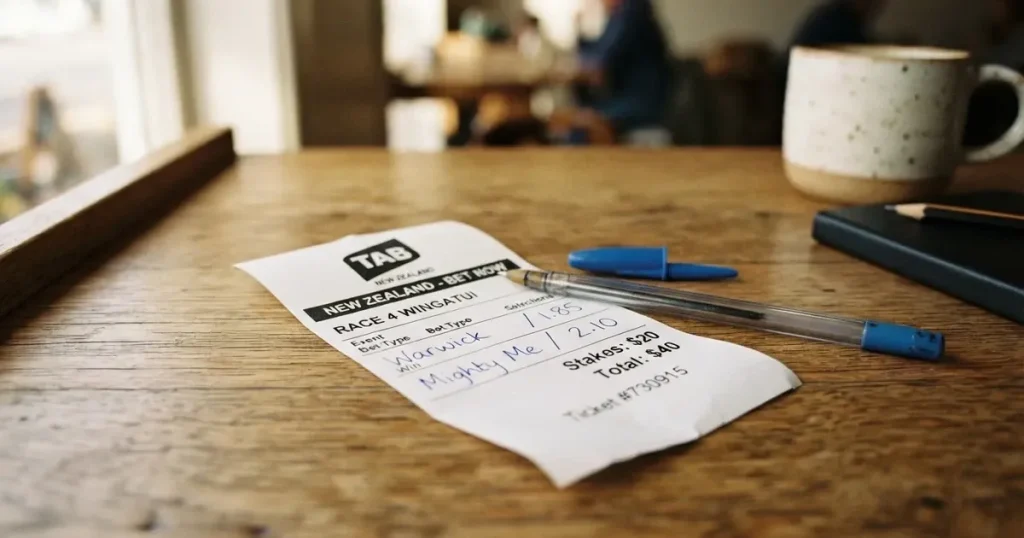
An arbitrage bet only beats the bookmaker when the numbers genuinely line up, and for a New Zealander those numbers run into a hard wall before they start. The law now lets one operator group take racing and sports bets online. A technique that needs several bookmakers running different prices on the same event cannot be run inside that closed market. What follows weighs what arbitrage betting actually is, what it costs to attempt, and where a New Zealand bettor realistically stands in 2026.
Current as of October 30, 2026 and checked against the Racing Industry Act 2020, section 74AAA, in force since 28 June 2025.
Staying in control of the bet — and the budget behind it
Arbitrage betting makes losing sound impossible. The math says one outcome of every possible event is locked in, the stake comes back, and profit follows regardless of who wins. That certainty is what lures people who never otherwise sit through a Saturday of races. It is also what makes the technique dangerous, because the budget it eats is rarely the budget a reader imagines.

A 2012 academic study by Franck, Verbeek and Nuesch found that 98% of arbitrage opportunities return less than 1.2% of the stake. To make that 1.2% feel like a wage, a bettor is being pushed toward ever-larger sums on ever-thinner margins. The first losing streak is not really a losing streak — it is a stake that did not earn its fee. What compounds is not the loss but the turnover needed to extract the gain: the bookmaker wants its margin back from the volume.
That shape — small return, big stakes, plenty of bets to clear a tiny edge — is the reason the responsible-gambling advice for this corner of the market runs longer than the betting advice. A few habits matter more than a few picks:
- Set a hard monthly loss limit that is comfortable to lose entirely, and treat the deposit ceiling in the TAB NZ app as the cap, not as a target.
- Use time-outs and self-exclusion as tools, not as last resorts — the New Zealand Gambling Helpline (0800 654 655, text 8006) is free and confidential, and Safer Gambling Aotearoa publishes the same number plus online chat.
- Remember that arbitrage only works for those who can afford to keep placing bets at full stake after a near-miss. If a single losing week changes the household’s week, the technique costs more than it pays.
- Watch for the warning signs that promotion-driven gambling carries: chasing missed arbs, raising stakes to “recover” turnover, betting while tired or upset, hiding what is being wagered from family.
The TAB NZ app exposes deposit limits, time-outs and self-exclusion directly, and an exclusion there applies across both TAB and Betcha because both sit under the same licence. Harm minimisation in this market is a real feature, not a marketing line — the operator is the same one in both cases and the operator is the regulator’s only subject. If the budget starts to feel less like a budget and more like a target, that is the moment to step back, not the moment to increase the stake.
Why some bettors reach for crypto and offshore brands
Search traffic for arbitrage betting in New Zealand keeps dragging in crypto terms — bitcoin arbitrage, pseudonymous wallets, an opportunity that lives “offshore” because the law does. The pull is real: the New Zealand market is closed, and a wallet does not ask for a New Zealand address. What follows is what that path actually looks like, not a recommendation to take it.

TAB NZ requires a verified New Zealand address and ID to open an account. That is the regulator’s condition, not the operator’s choice, and it is the filter that sits between a New Zealander and every licensed alternative. The Racing Industry Act 2020, as amended in 2025, makes TAB NZ the only operator allowed to take online sports and racing bets from people in New Zealand, regardless of where the operator is incorporated. The Department of Internal Affairs told providers serving New Zealand to withdraw with immediate effect when the law took effect on 28 June 2025.
Offshore brands keep appearing in search results because SEO for arbitrage terms is global and New Zealand readers cannot easily tell which sites are licensed where. The brands listed in the operator section below all carry their own house rules under licences that give no right to take bets from people in New Zealand — Curaçao, the Union of the Comoros, the Tobique Gaming Commission, Costa Rica incorporation. None of these is a New Zealand licence. None of them places the bettor under the Gambling Act 2003 or the Racing Industry Act 2020. None of them is reached by New Zealand’s complaints or harm-minimisation framework. That is what “offshore” means in practice: a different regulator’s rules, a different complaints route, and the Department of Internal Affairs’s standing warning that overseas operators may not return unspent credits or pay out large wins.
Crypto adds a second layer. Bitcoin and stablecoin rails remove the bank from the deposit trail, which is exactly what an arbitrage bettor who fears an account closure wants. The trade is real: the offshore operator never sees a New Zealand bank account, and the New Zealand bank’s view of gambling transactions stops. What is bought with that privacy is also real — no recourse through the New Zealand system when a payout does not arrive, no recourse through the issuer’s home regulator on terms the reader can recognise, and no recourse at all if the wallet’s anonymity is the very thing the operator uses to keep the account open while restricting withdrawals.
TAB NZ has never published a rule on crypto or VPN use, and the law says nothing about payment rails specifically. What the law does require is a New Zealand address to hold a TAB NZ account. The honest summary is straightforward: the offshore-crypto path exists, the regulator warns against it, and the player carries the full risk of an account closure, an unpaid balance, and a complaint that no New Zealand body can hear.
What an arbitrage opportunity actually looks like
The word “arbitrage” makes a simple idea sound clever. Take one event with two outcomes — who wins, who loses, or whether the total goes over or under a line. Find two bookmakers who disagree on the price. Bet on every outcome in proportions that recover the stake and lock in a small profit, no matter who wins. The technique works on paper when the implied probabilities of the odds, summed, fall below 1.
The way to read an odd is to flip it. Decimal odds of 2.00 imply a 50% chance. Decimal odds of 1.90 imply about 52.6%. Decimal odds of 4.00 imply 25%. Add the implied probabilities of every outcome of a market together, and the sum tells the reader exactly what is going on:
- Sum above 1: the bookmaker’s margin is baked in. The reader loses on average.
- Sum equal to 1: a “fair” market, vanishingly rare in commercial betting.
- Sum below 1: a genuine arbitrage. The reader is paid by the bookmaker, on average.
Reading odds as implied probabilities is the single change that demystifies the whole craft. “Best odds” stops being a marketing phrase. A “boosted price” becomes a number. The arbitrage condition stops being a calculator’s mystery and starts being one subtraction the reader can do on the back of a betting slip.
Selection, settling and staking
Three terms carry the rest of the technique.
Selection is the bet itself. For arbitrage, the selection is not one outcome; it is a small bundle of mutually exclusive outcomes, one per bookmaker, covering every way the event can resolve.
Settling is the moment the bookmaker pays out, or does not. Different bookmakers settle at different speeds. The arbitrage window is the gap between the bets being placed and the event resolving: a slow settlement can mean a stake is committed elsewhere at the same time, and a sharp bookmaker can void a price before kick-off if it sees an obvious mistake.
Staking is the arithmetic of the stake split. The legs must be proportional to the inverse of the odds, so that whichever outcome lands returns exactly the desired profit. A stake of $100 at 1.90 paired with $100 at 1.90 does not return even money — the implied probabilities add to over 105%, and the bookmaker keeps the difference.
Two-way and three-way markets
A two-way market — who wins, who does not — is the cleanest case. Three-way markets (home win, draw, away win) add a leg but follow the same rule. The more outcomes a market has, the more bookmakers the technique needs to find disagreeing prices, and the more chances the bookmaker has to spot what is happening.
How an arbitrage is closed in practice
The cleanest way to close an opportunity is to do the arithmetic on a $200 stake.
With two bookmakers offering 1.90 on opposite sides, the implied probabilities sum to 105.26%, so the position loses roughly $10 of every $200 staked, on average. That is the textbook situation for any price the reader sees — the bookmaker keeps a margin and the reader cannot win on average.
For an arbitrage to actually exist, two bookmakers need to disagree enough that the implied probabilities sum below 100. Suppose one site is at 2.10 on outcome A and another is at 2.05 on outcome B. The implied probabilities are 47.62% and 48.78%, summed to 96.40%. The remaining 3.60% is the reader’s expected profit before juice.
Stake the inverse-odds shares. A stake of $100 on outcome A at 2.10 and a stake of $97.62 on outcome B at 2.05 means whichever side wins returns roughly $210 or $200.13. Deduct the combined stake of $197.62 and the gain is $10 to $12, roughly 5-6% on the combined stake before fees. That is the kind of margin that has to chase volume to look like a wage, and it is also the kind of bet that gets an account limited.
The same logic extends to same-game multis, boosted odds markets, and lay bets at exchanges — but with two important wrinkles. First, a multi’s odds multiply, so a single leg going wrong costs the whole stake, and the bookmaker’s margin compounds across the legs. Second, a lay bet pays when the selection does not win, so the technique has to be tuned to the inverse market the exchange offers, and the reader pays commission on the winning side of the position.
The bookmaker’s view
Bookmakers publish odds for a living. An arbitrage bettor looks like a customer who is uninterested in the sport and interested only in price, who stakes the maximum allowed at every new price, and who withdraws as soon as the event settles. That profile reads as risk to a trading team. Their counter-measures include maximum-wager limits that drop sharply on flagged accounts, odds that move the moment the wrong stake shows up, promotions that exclude the obvious arbs, and outright account closure.
The phrase that recurs across bookmaker forums is “palpable error” — a price they published and did not mean to. Even an honest price disagreement becomes voidable the moment it looks like one side of the position was a typo. None of this is conspiratorial; it is the steady answer the industry gives to a customer who is paid to be its counterparty.
Top bookmakers and offshore brands in New Zealand 2026
The reviewed set splits cleanly into two camps, and the page treats them as such without ever merging the groups. TAB and Betcha are the two online brands of TAB NZ, the only operator allowed to take racing and sports bets from people in New Zealand; the eight brands below are listed as references because New Zealand readers meet them, with their New Zealand status as a no-data marker across the comparison columns. The order below runs from the lawful brands to the unlicensed set.
| Brand | New Zealand status | What the operator’s own terms say about arbitrage-style betting |
|---|---|---|
| TAB | New Zealand’s lawful racing and sports betting operator (TAB NZ) | Stakes at the operator’s own limits; rules in the published Betting Rules; bonus bets promotions available |
| Betcha | New Zealand’s lawful racing and sports betting operator (TAB NZ) | Daily Toolbox with odds boosts and insurance tools; Playbook of tips and match analysis; Bet Social with following and shared bets |
| Glorion | Not licensed in New Zealand | — |
| BillyBets | Not licensed in New Zealand | — |
| Roobet | Not licensed in New Zealand | Curaçao licence (OGL/2024/687/0427); crypto deposits listed; no New Zealand-specific terms |
| 22Bet | Not licensed in New Zealand | Curaçao licence; singles, accumulators, systems, chains and live betting |
| Rabona | Not licensed in New Zealand | Curaçao licence; combined sportsbook and casino product |
| Golden Panda | Not licensed in New Zealand | Sports Terms and Conditions cover fixed-odds betting, Combo Bets, Bet Builder, live scoreboards and broadcasts, stake and odds limits |
| BetNinja | Not licensed in New Zealand | Union of the Comoros licence; combined sportsbook and casino product |
| FunBet | Not licensed in New Zealand | — |
The table is short on purpose. Eight of the ten brands are referenced, not reviewed; cells without data stay empty rather than dressed up. Below, each operator gets one paragraph on what their own terms actually say, with no claim made about the rest.
TAB
TAB is the older face of TAB NZ, the racing and sports betting monopoly that has been operating in one form or another for generations. Its app, “TAB – Racing & Sports Betting”, is published on the New Zealand App Store under the seller name New Zealand Racing Board and was first released on 8 September 2014. Accounts require a verified New Zealand address and ID; safer-gambling tools — deposit limits, time-outs and self-exclusion — are exposed in the app, and an exclusion covers both TAB and Betcha. Promotion activity under the “bonus bets” label is published in the operator’s own terms and is the only New Zealand-licensed route to a promotional offer in this market.
What sets TAB apart for an arbitrage bettor is the impossibility of the task. As the only operator licensed to take online racing and sports bets from people in New Zealand, there is no second bookmaker to disagree with on price. The closest the technique gets inside the lawful market is the Fixed Odds book versus the tote (pool) on racing, where the two product lines are run by the same operator and any disagreement on price is internal.
Betcha
Betcha is the second online brand of TAB NZ, run in parallel with TAB and aimed at a younger and more app-native audience. The app’s daily Toolbox publishes odds boosts and insurance tools that protect bets which do not land. A Bet Social section sits in the same product: punters can chat, follow tipsters and share bets or pools, and a Playbook of tips and match analysis is curated in-house.
The arbitrage question runs the same way here as on TAB. Betcha is part of the TAB NZ group, run under a 25-year Entain partnership signed in 2023, so even the appearance of two prices on the same event is two tabs of the same trading desk. From the bettor’s point of view, comparing the two brands is comparing two products on the same licence, not two independent bookmakers.
Glorion
Glorion runs customer support through live chat and email and is open to customers aged 18 and over. There is no claim of a New Zealand licence, and the operator falls outside the Racing Industry Act 2020’s section 74AAA: only TAB NZ may offer racing and sports betting to people in New Zealand.
For a New Zealand bettor, the relevant question is what protection applies when an account has a balance that cannot be withdrawn, an odds movement that looks suspicious, or a bonus whose terms read differently after a closer look. The answers do not run through the New Zealand system.
BillyBets
BillyBets offers three odds formats — Decimal, American and Fractional — and runs cashback and reload bonuses on the sports side, a coin shop that exchanges coins earned from deposits, betting, tournaments and challenges into free bets and free spins, and a five-level VIP programme. None of this is regulated in New Zealand; the brand is not approved by the Department of Internal Affairs.
The product is built around promos and conversion paths from casino to sportsbook. The terms that govern the bonus and the VIP schedule matter for the bettor’s bottom line, and the New Zealand reader reads those the same way they do at any unlicensed bookmaker: as the operator’s terms, not as a New Zealand consumer guarantee.
Roobet
Roobet is a brand name of Raw Entertainment B.V., registered in Curaçao (registration 157205, Korporaalweg 10) under Curaçao licence OGL/2024/687/0427. Crypto deposits are central to the product. The Curaçao licence gives no right to take bets from people in New Zealand under section 74AAA.
The arbitrage reader is the audience Roobet courts: a customer who is paid to take price, who moves quickly between bookmakers, and who values a wallet they control. The trade-offs are also the ones arbitrage readers accept: no New Zealand complaints route, no recourse against the operator through any body the bettor recognises, and the standing Department of Internal Affairs warning that overseas operators may not return unspent credits or pay out large wins.
22Bet
22Bet takes single bets, accumulators, systems and chains, with live betting on real-time odds and score updates. The brand is operated under a Curaçao licence (8048/JAZ) by TechSolutions Group N.V. and is open to players in many countries outside New Zealand.
For a New Zealand reader, the offer is one of the wider sportsbooks an arbitrage bettor might encounter, with deeper market coverage than most New Zealand-facing sites. The same two objections apply to 22Bet as to the rest of the offshore row: no New Zealand licence, no New Zealand protection regime, and a regulator in a jurisdiction that does not enforce New Zealand consumer law.
Rabona
Rabona launched on 23 December 2019 as the sixth online sportsbook of the Soft2Bet group, under a Curaçao licence. The product covers the standard major sports with a heavy casino component alongside it.
A New Zealand bettor who opens an account is doing so against the operator’s terms, which are Curaçao law, not New Zealand law. The same Department of Internal Affairs warning applies. The brand’s product is comparable to many of the others in this row, and what distinguishes it for an arbitrage reader is its market depth on football and basketball, where the bulk of the global arbing action sits.
Golden Panda
Golden Panda publishes dedicated Sports Terms and Conditions covering fixed-odds betting, Combo Bets, the Bet Builder feature, live scoreboards and broadcasts, and stake and odds limits. The sportsbook sits alongside a casino product. There is no claim of a New Zealand licence.
The dedicated Sports Terms are worth flagging — not every offshore bookmaker publishes them. A bettor who reads them carefully gets a clearer picture of the operator’s rules than at a competitor that handles bonuses and sportsbook under one set of casino-style terms. The rules are still not New Zealand rules.
BetNinja
BetNinja states that it is licensed to conduct online gaming operations by the Union of the Comoros. The Union of the Comoros licence is one of the more frequently-issued offshore licences; it grants no right to take bets from people in New Zealand.
The product surface covers the standard major sports. New Zealand readers read the licence disclosure as evidence the operator is regulated somewhere, not as evidence the operator is regulated in New Zealand. The Department of Internal Affairs’s warnings apply in full.
FunBet
FunBet covers football, ice hockey, American football, basketball, volleyball, tennis, rugby and baseball, with live betting and a bookmaker described as open around the clock. There is no claim of a New Zealand licence.
A New Zealand reader who opens a FunBet account is doing so on Curaçao-style terms against an unregulated-in-New-Zealand bookmaker. The breadth of markets is appealing for an arbitrage bettor who wants a price taken quickly, and the same caveats apply as to the rest of this row.
Why the New Zealand market looks the way it does in 2026
The shape of arbitrage betting in New Zealand is set by section 74AAA of the Racing Industry Act 2020, which took effect on 28 June 2025 and amended the original 2020 act. The amendment made TAB NZ the only operator lawfully entitled to offer racing betting, sports betting or “other racing or sports betting” to a person in New Zealand, “regardless of where that person is resident or incorporated”. The Department of Internal Affairs told providers serving New Zealand to withdraw with immediate effect.
The Racing Industry Amendment Act 2025 inserted the section as a clean break with the prior regime, which licensed a small number of bookmakers. There is no longer a licensing route for another betting operator and no licence register for bookmakers because there is only one lawful operator to register. TAB NZ is run under a long-term partnership with Entain, signed in 2023 for 25 years, with a 50/50 share of gross profits between the two parties and a guaranteed minimum of $150 million a year going to TAB NZ for the first five years; Entain paid a one-off $100 million to the racing sector as part of the deal. Betcha is the second online brand under the same TAB NZ umbrella.
The Online Casino Gambling Act 2026 creates a separate regime for online casino gambling only. The casino law does not extend the betting monopoly and does not create a competing bookmaker licence; winning the right to apply for a casino licence does not mean TAB NZ can offer casino games under the betting licence, and a casino licence does not let a third party take sports bets from people in New Zealand.
A few consequences flow from this. There is no statutory payment rule for betting accounts — no rule on cards, bank transfers, credit, prepaid cards or crypto specifically. The age for TAB NZ betting is 18 (an offence under section 89 of the Racing Industry Act 2020), although land-based casinos keep their existing 20-year age limit. Inland Revenue treats recreational gambling winnings as generally not taxable, with prize money from TAB horse, dog and trotting races explicitly non-taxable, while a person who bets as a business falls into a different tax treatment. Advertising is governed by the Advertising Standards Authority’s Gambling Advertising Code, which prohibits ads that target under-18s or encourage harm, and which requires truthful terms to be available, but does not apply a “whistle-to-whistle” ban on broadcast betting advertising as some other markets have done.
For a New Zealand reader, the practical picture is narrow by design. The lawful choices are TAB and Betcha, both under one licence, both subject to the same harm-minimisation framework, both feeding the same Problem Gambling Levy (0.74% in force from 1 July 2025 to 30 June 2028). The greyhound racing code is closing in stages from 1 August 2026, and from that date offshore operators may not take bets on greyhound races either. Every other racing and sports bet a New Zealander places online must run through one of those two apps.
The worked arithmetic — what a price actually keeps
Decimal odds turn a price into an implied probability. Add the implied probabilities of every outcome in a market together, and the sum tells the reader exactly what the bookmaker keeps of every dollar staked. The result is the margin of the market.
Consider an illustrative two-way market at decimal odds 1.90 and 1.90. The implied probability on each side is 1 ÷ 1.90, or 52.63%. The two sum to 105.26%. The payout share is 1 ÷ 1.0526, or about 95.00%. The margin is the rest: roughly 5.00%.
That 5% is what the bookmaker keeps, on average, from every unit bet on this market over time. A reader who places a single $20 bet on one outcome at 1.90 is risking $20 to win $18 of profit, and on average over many similar bets is paying $1 of that $20 to the bookmaker’s margin.
The shape moves with the odds. Two-way markets at 1.95 and 1.95 (implied 51.28% each, summed 102.56%, margin roughly 2.50%) favour the reader more; two-way markets at 1.85 and 1.85 (implied 54.05% each, summed 108.11%, margin roughly 7.51%) weigh heavier against the reader. This is why bookmakers’ margins look very different from sport to sport and from market to market — top-flight football with deep liquidity runs tight, niche outright markets with thin liquidity run wide.
The same arithmetic generalises to three-way and prop markets. Add the implied probabilities, divide 1 by the sum, subtract the result from 1, and the difference is the bookmaker’s margin on that market. The number carries through to the same conclusion as the worked example above: most markets lose to the reader on average, and the only markets that pay the reader on average are the genuinely rare arbs whose implied probabilities sum below 1 and whose existence the bookmakers quickly notice.
Strategic mistakes arbitrage readers make
The technique attracts a certain kind of reader. The reader is mathematically literate, often technically capable, comfortable with multiple accounts, and motivated by the idea of beating the system for a wage. That profile also tends to make the same half-dozen mistakes.
Chasing the closing line. Moving the stake up to maximise a marginal opportunity routinely increases volume without increasing expected profit, because the same margin sits inside the bigger stake. Turnover scales linearly; the long-run cost scales the same way.
Misjudging the void. Bookmakers reserve the right to void bets on what they call “palpable errors” — prices they did not intend to publish. A position built around a price that is later voided is a position without a backstop. Reading the operator’s terms around voids and errors is non-optional.
Forgetting the lay side. On a betting exchange, the technique works the other way: lay every outcome and pocket the backer’s stake. But lay bets attract commission on net winnings, and the exchange’s margin is its own number. Combining back and lay across an exchange and a bookmaker can look like an arbitrage and behave like a margin.
Underestimating the time cost. The number of arbs available to a New Zealand reader is small by construction — the market is closed. Placing and tracking a position with offshore brands requires accounts in good standing, payment rails that work from New Zealand, and patience with voids and limits. The arithmetic returns a thin margin; the labour eats it.
Reading “withdrawal guaranteed” as a guarantee. The Department of Internal Affairs has warned that overseas operators may not return unspent credits and may not pay out large wins. That warning is a one-line summary of what happens in the cases the regulator actually sees. The guarantee in an offshore operator’s terms is its own guarantee under its own regulator.
Building the technique around bonuses. A “free bet” is rarely a free bet — the stake is usually not returned with the win. The arithmetic the operator publishes on the offer is the arithmetic the operator chose to publish. The actual cost of clearing the bonus sits inside the bookmaker’s margin over the turnover, and the turnover can be several times the bonus amount. This page does not name any current promotion or voucher; the bonus-clearing calculation is the same arithmetic with different numbers.
What to read, what to check, what to avoid
A New Zealand reader has three honest choices to make in 2026. Choose TAB and Betcha, both under section 74AAA, with the regulator’s harm-minimisation framework and the Gambling Helpline within reach. Choose an offshore bookmaker, knowing that the operator is breaking New Zealand law by serving you, that no New Zealand complaints route applies, and that the Department of Internal Affairs has warned about unreturned credits and unpaid large wins. Or do not bet at all.
The choice is the reader’s, not the page’s. The arithmetic above is the same for everyone, and so is the regulated framework. What the page adds is the part the marketing copy leaves out: the law, the limits, the working cost of the offer, and the realistic outcome of running the technique over a year.
A few last habits help every reader, not only the ones who try to arb. Read the operator’s published terms before funding the account. Set the deposit limit before the first bet. Pick one product — racing or sports — and learn how that one product prices, rather than skimming across all of them. Skip the tipsters who charge for guaranteed results; these have a habit of arriving just after the betting market has stopped quoting them. And remember the figure at the top of this page: a 2012 study found that 98% of arbitrage opportunities return less than 1.2%. The remaining 2% are the ones the bookmakers close down first.
Frequently asked questions
Does sports arbitrage betting work?
Arbitrage betting works in the sense that a genuine arbitrage — a market whose implied probabilities sum below 100% — does, on average, return a small profit. As noted, the Franck, Verbeek and Nuesch study found that only 2% of these opportunities return more than 1.2% of stake, so the technique needs large sums to look like a wage, and bookmakers quickly limit accounts that bet this way.
How to arbitrage bet?
To arbitrage bet, find a market whose outcomes are mutually exclusive and whose implied probabilities — the inverse of the decimal odds — sum below 100%. Stake the inverse-odds shares across two or more bookmakers; whichever outcome lands pays roughly the same return, leaving a small profit after the combined stake.
How is the return on a bet worked out from the stake and the odds?
For decimal odds, a winning bet’s return is stake × odds. A $20 bet at 2.10 returns $42 in total — the original $20 stake plus $22 of profit. A multi’s odds multiply across the legs, so the formula applies once to the multiplied odds rather than to each leg separately.
Which bookmaker may lawfully take sports and racing bets in New Zealand?
Section 74AAA of the Racing Industry Act 2020, in force since 28 June 2025, makes TAB NZ the only lawful provider of racing and sports betting to people in New Zealand. TAB and Betcha are the two online brands of TAB NZ; no other licensed bookmaker exists, and offshore brands taking bets from people in New Zealand are breaking the law.
What is the bookmaker’s margin and how can it be seen in the odds?
The bookmaker’s margin is the share of every unit staked that the bookmaker keeps on average. It is the difference between 100% and the sum of the implied probabilities across every outcome of a market — calculated as 1 minus 1 over the sum of the inverse odds. A two-way market at 1.90 and 1.90 has implied probabilities summing to about 105.26%, so the margin is roughly 5%.
How is arbitrage betting run from New Zealand?
In practice, a New Zealand reader cannot run a multi-bookmaker arbitrage inside the lawful market: TAB and Betcha are the same group, and there is no second licensed bookmaker to disagree on price. A position built across an offshore brand and another offshore brand runs against New Zealand law on the operator side, with no New Zealand complaints route and the Department of Internal Affairs’s standing warning about unreturned credits and unpaid large wins.
Tips & strategy – kiwibettingbonuses
Content created by the «kiwibettingbonuses» team
