
Snooker betting in New Zealand after the 2025 betting monopoly: the law, the odds and the choice
 Available in US

Snooker betting in New Zealand sits inside the narrowest legal market in this pack. Since 28 June 2025, only one operator group may take a sports or racing bet from a person in New Zealand, and that monopoly reshapes what “choice” means on a snooker coupon. Two of the ten brands reviewed below are lawful to bet with; the other eight are listed because New Zealand players meet them in advertising and on apps, and because the comparison still tells a reader what each one is. The angle of this page is the choice that remains — which lawful path to use, which offshore brand a budget-conscious reader may weigh against the cost of having no New Zealand complaints route, and where the snooker calendar hands the punter enough liquidity for prices to matter.
Current as of October 30, 2026 against the Racing Industry Act 2020 (as amended by the Racing Industry Amendment Act 2025) and the Department of Internal Affairs’ October 2026 statement on the betting monopoly.
How New Zealand’s Betting Market Works in Practice
The whole question of where a snooker bet can be placed turns on one section of one statute. Section 74AAA of the Racing Industry Act 2020, inserted by the Racing Industry Amendment Act 2025, says no person other than TAB NZ may offer racing betting, sports betting or other racing or sports betting to a person in New Zealand, regardless of where that person is resident or incorporated. The Department of Internal Affairs told providers serving New Zealand customers to withdraw with immediate effect, and the change took effect on 28 June 2025. The page takes the regime as it reads in 2026: one lawful operator group, two online brands, no licence route to apply for and no register of licensed bookmakers because there is only this one body to register.

The lawful operator is the New Zealand Racing Board, trading as TAB NZ, and it runs two consumer-facing brands — TAB at tab.co.nz and Betcha at betcha.co.nz. Behind the customer-facing brands sits Entain NZ, which operates the TAB business under a 25-year agreement signed in 2023; Entain takes a 50/50 share of gross profits with TAB NZ, with at least $150m a year guaranteed to TAB NZ for the first five years, and Entain committed a one-off $100m payment to the racing sector on signing. The two brands are not rivals: they are two windows onto the same betting pool, and the prices on a given match are identical because both brands are run off one pricing engine.
A few practical points fall out of that single-operator frame. There is no application fee, no licence register to check a brand against, and no second betting exchange to route orders to. The market list — the set of tournaments, matches and markets the punter actually wagers on — is whatever TAB NZ publishes in its own terms. Offshore brands do still advertise to New Zealand customers through affiliate content, app-store placements and search; the law targets the operator taking the bet, not the player placing it. Section 19(4) of the Gambling Act 2003 (inserted in 2025) says an individual may not be convicted for placing a bet with an offshore operator in breach of section 74AAA, so the page can name what is true of each brand without inviting a reader to break the law.
For the punter the choice is structurally narrow but operationally wider than it looks. The market list belongs to one company, but inside that menu a snooker bettor still picks a bet type (frame winner, handicap, totals, outright), a stake level, an in-play or pre-match window and a responsible-gambling setting. A reader looking for “choice” in this market will not find it across operators — they will find it across markets within one operator, and across the cash-out, live and same-game-multi options the operator exposes.
Where the Snooker Calendar Lands
The professional snooker season runs almost year-round, with the World Snooker Tour scheduling ranking events, invitationals and the World Championship as the calendar’s centre of gravity. Snooker itself is played with 22 balls — a white cue ball, 15 reds and six colours worth yellow 2, green 3, brown 4, blue 5, pink 6 and black 7 — on a full-size table 12 ft by 6 ft with six pockets, and most professional matches are best of 7, 9 or 11 frames depending on the round. The maximum break is 147, made by potting all 15 reds with blacks and then all six colours in sequence, and a punt on a match winner has to absorb the variance of a sport where a single session can swing three frames off a missed pink.
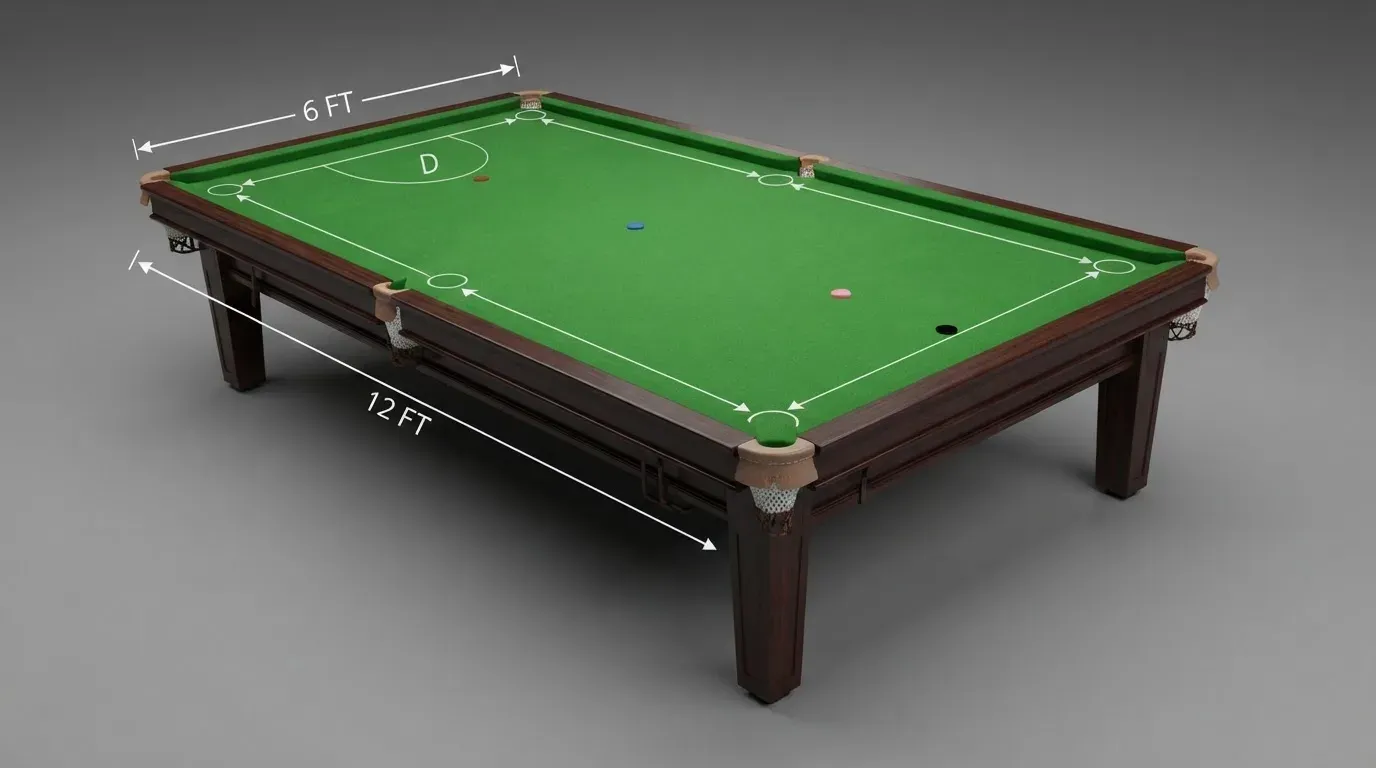
The headliner is the World Snooker Championship, held at the Crucible Theatre in Sheffield since 1977. Rounds stretch from best of 19 frames in the first round out to best of 35 in the final. The 2026 final finished 4 May 2026 with Wu Yize beating Shaun Murphy 18-17; the winner’s share was 500,000 in prize money from a 2,395,000 total prize fund. Stephen Hendry and Ronnie O’Sullivan each own seven world titles in the modern era; Joe Davis won 15 in a row from 1927 to 1946, the historical benchmark every modern champion is measured against.
The Masters, held in January at Alexandra Palace, and invitational events like the Champion of Champions sit just below the Worlds in prestige and carry similar frame counts. Ranking events such as the China Open, the UK Championship and the Welsh Open rotate through the calendar and produce the bulk of the weekly market list on a TAB NZ account. The amateur game is governed separately by the International Billiards & Snooker Federation (IBSF), and the professional tour sits under the World Professional Billiards and Snooker Association (WPBSA).
The practical implication for betting is liquidity. The World Championship, the Masters and a handful of invitationals attract enough betting volume that prices hold their full precision down to the third or fourth frame. Outright markets on the season-ending events open weeks before the tournament and settle into a stable shape as the draw is known. For a punt, that window — between draw and first round — is often the most mispriced part of the calendar, because bookmakers and model-builders disagree on which qualifier to favour.
A Bet’s Mechanics — Stake, Odds and Margin
Three numbers sit inside every snooker coupon: the stake, the decimal odds, and the bookmaker’s margin. The arithmetic belongs to the reader before it belongs to the operator, because the same stake at the same odds returns the same amount regardless of which brand carries the coupon — what changes between brands is the margin baked into the price.
A decimal odds quote is the number a $1 stake multiplies into if the bet wins. The return on a winning bet at odds of $2.50$ is $2.50$ for every $1$ staked, of which $1.50$ is net profit because the original dollar is returned with the payout. A combination bet multiplies the odds of each leg into one price: a two-leg multi at $1.80$ and $2.20$ pays $3.96$ per $1$ staked if both legs win. The mechanic is identical across the industry.
The margin is what the operator keeps of every unit bet on a market. Take a two-way match winner priced at the round figure of $1.90/1.90$ — the kind of snap-even price that looks generous on a coupon. The implied probability of each side is $1/1.90 = 0.5263$, or 52.63% each. Add the two together and you get $1.0526$, or 105.26% — that 5.26 percentage points above 100 is the overround, and on this market it implies a margin of about 5% on turnover. State it more carefully and the payout share on this illustrative two-way market is roughly 95%, the margin roughly 5%. That is a tight snooker price by industry standards; an outright market or a player handicap will carry materially more.
The honest framing for a punter is that the margin is the cost of the bet before a ball is pocketed. Two cents in the dollar on a single bet is two cents in the dollar whether the bet wins or loses. Across a season of small bets it is the line a careful reader watches, and it is the line the lawful New Zealand bookmaker is not visibly competing on — there is no rival price to compare to on the same event.
The Bet Types a Snooker Coupon Carries
The market list on a World Championship or Masters frame splits into a small handful of recurring types. Match winner is a 1X2-style bet on who wins the match (in a sport without a draw, it is two-way, not three-way). Frame winner is the in-play analogue of match winner, priced frame-by-frame as the match unfolds. Handicap gives the underdog a frame start or the favourite a frame deficit, settled on the final score; the line is usually expressed as +1.5, +2.5, –1.5 or –2.5 frames depending on the expected margin. Totals are over/under on the total frame count in the match, most often priced at the round number of frames a best-of-N match is scheduled to run. Outright is the tournament winner market, priced from the draw’s release and settled at the trophy lift. Each-way is a tournament-each-way structure on the outright market, paying a fraction of the win odds for a place finish — most often a quarter of the odds on a top-half finish or top-four finish depending on the event’s each-way terms.
A TAB NZ same-game multi combines several frames-from-one-match legs into one betslip at multiplied odds; if one leg is voided the multi typically settles on the remaining legs rather than being voided outright, but the specific settlement of any one offer lives in the operator’s terms. The market depth on a marquee match (Worlds final, Masters final, a top-eight ranking event semi-final) is materially wider than on a first-round qualifier, and the prices on a thin match reflect that.
Live Betting and Cash Out on a Snooker Match
Live betting on snooker sits naturally inside the format. A frame-by-frame sport with discrete scoring events gives the bookmaker regular points to reprice, and the in-play margin is normally wider than the pre-match margin because the model has to clear at speed. The TAB NZ apps list live betting on snooker as part of the broader sportsbook; the cash-out feature lets the punter lock in a position mid-match at a price the operator quotes, accepting a smaller margin than waiting for the match to settle.
Cash-out is a settlement, not a refund: it closes the bet at the price shown at the moment of cashing, and the amount returned is the operator’s current valuation of the position, less its own margin. The mechanic is useful when the punter wants to bank a winning position before a comeback or trim the loss on a bet that is going wrong, and it is unhelpful when the cash-out price is materially worse than the position’s fair value — because it is, always, by definition. A reader who treats cash-out as a free option has misunderstood what it costs.
Live betting more generally carries the snooker punter into the part of the calendar where liquidity thins. A long best-of-19 frame in the World Championship first round, with one player five frames clear at the mid-session interval, attracts limited live action because the result looks settled; a tight 9-7 in a Masters semi is a different market entirely. The TAB NZ pricing will move on the snooker live tab as the match state changes, and a punter watching the stream and the price can model the favourite’s drift before the bet settles.
The Responsible-Gambling Tools TAB NZ Builds In
The lawful New Zealand bookmaker carries the responsible-gambling framework the law requires. TAB NZ’s apps include deposit limits, time-outs and self-exclusion, and an exclusion applies across both brands (TAB and Betcha) because they sit under one operator. The app surfaces the free Gambling Helpline (0800 654 655) and the text line 8006, both run as part of Safer Gambling Aotearoa. The age for placing a TAB NZ bet is 18; the land-based casino age is 20, and the two are not interchangeable. Account opening requires a verified New Zealand address and ID — a threshold that offshore brands do not enforce against New Zealand addresses.
TAB NZ also pays the Problem Gambling Levy of 0.74% of its gross profits, in force from 1 July 2025 to 30 June 2028, into a fund that pays for treatment services and harm-minimisation work. The levy is the operator’s contribution to the framework; for the punter, the practical tools are the ones embedded in the app. A reader placing a bet under stress or chasing a loss has fewer recourses on this side of the market — but the recourses that exist are designed for them, and the offshore alternatives offer none.
Offshore Brands and What They Cost the Punter
A New Zealand-resident punter will, in everyday browsing, encounter ten brands and place bets through two of them. The other eight — BetNinja, Alawin, 22Bet, BetAlright, Sportaza, BillyBets, RoyalistPlay and Telbet — accept New Zealand sign-ups, advertise into the New Zealand market, and run on licences that have no application to New Zealand law. Each holds an offshore licence (Curaçao, Anjouan, Tobique, the Union of the Comoros, or no stated licence at all). None of those licences entitle the brand to take a bet from a person in New Zealand, which is what the law makes unlawful on the operator side.
The Department of Internal Affairs is explicit about the cost on the player side: an offshore operator may operate in a jurisdiction with minimal consumer safeguards, may not return unspent credits, and may decline to pay out large wins. There is no New Zealand complaints route for an offshore brand, no New Zealand self-exclusion register that covers them, and no recourse to the Department of Internal Affairs, the Advertising Standards Authority or the Gambling Commission if a dispute arises. A reader who opens an account with one of them has, in operational terms, no regulator at their back.
The right frame is that TAB NZ and Betcha are the lawful option with harm-minimisation tools and a regulator; the offshore brands are unlawful for the operator to serve, with the player-protected wording the law actually permits. Neither is a default “safe choice”. A page that describes the difference is more useful to a punter weighing a $50 multi than a hundred words on geo-blocking. New Zealand does not block offshore websites; the law targets the operator, not the player. No published penalty for an individual New Zealand punter using an offshore brand was found.
Picking a Snooker Bet — What a Punter Looks For
Snooker is a small betting market by comparison with football or tennis, and the prices on a quiet match reflect that. A punt looking for edge in a World Championship first round is working off a smaller information set than a punt looking at an FA Cup tie; the public models that price football matches do not exist in the same form for the Crucible, and a serious snooker price is built more from form tables and head-to-heads than from any single feed.
A reasonable starting point is the outright market on a major event. Outright markets open weeks ahead of the tournament, and the price on a top seed or an in-form qualifier is often mispriced relative to the model’s true probability — the draw has not been played, the conditions vary, and the early money shapes the line. A second look is at frame handicaps on a format-heavy round (best of 25 or best of 35). The handicap line moves slowly through the early frames, and a punt who watches the first session has an informational lead on a model working off end-of-match form.
Pre-match and live meet in the frame-by-frame market. A punter can take a price before the match at, say, 1.85 on the favourite, watch the first session, and cash out at 2.10 if the favourite goes three frames up — or hold to settlement if the match stays tight. The cost of holding is the in-play margin plus the risk of a swing; the cost of cashing is the operator’s valuation of the position, which is always worse than fair because that is what cash-out is. A reader who treats the two as separate bets — pre-match value and live execution — is closer to the actual mechanics than a reader who treats snooker betting as a prediction exercise.
There is no published “system” or “method” that beats the snooker market over the long run, and no serious source claims one. What beats the market, where anything does, is the disciplined use of small information edges (form, head-to-head, conditions, schedule density) at prices that clear the margin. The arithmetic is the same as in any other sport: the punter pays the margin on every bet, and the only way to come out ahead is to find prices whose overround is genuinely smaller than the edge. That is rare, and the punter who claims it is regular is usually the punter who has not measured it carefully.
The Ten Bookmakers Reviewed — A Landscape View
The landscape of brands a New Zealand snooker punter meets in 2026 is short on the lawful side and long on everything else. The table below lays them out by New Zealand status and the operator’s own published offering in the sport and the markets this page covers. The “official New Zealand status” column splits the brands the way the law does: one group is the two brands of TAB NZ; the other group is the offshore brands, none of which holds a licence to take bets in New Zealand.
| Brand | Official New Zealand status | What the operator’s own terms state |
|---|---|---|
| TAB | One of two online brands of TAB NZ, the only provider lawfully offering racing and sports betting to people in New Zealand | TAB NZ’s apps list horse, harness and greyhound racing, rugby union and rugby league, and other sports, pre-match and live; the snooker coverage tracks the World Snooker Tour schedule as published by the operator |
| Betcha | One of two online brands of TAB NZ, the only provider lawfully offering racing and sports betting to people in New Zealand | Entain NZ publishes Betcha as a sports-and-racing-only brand; snooker is offered within the same wagering menu as TAB, with the same pricing engine underneath |
| BetNinja | NOT licensed in New Zealand; named licence is the Union of the Comoros, no New Zealand complaints route | Casino welcome and a 100% sports match up to EUR 100 on the first deposit in the operator’s own terms; snooker market depth not stated |
| Alawin | NOT licensed in New Zealand; no licence stated that applies in New Zealand, no New Zealand complaints route | Sportsbook covers football, tennis, basketball, ice hockey, American football, baseball, plus Live Betting, Virtual Sports and esports; snooker not listed on the home page |
| 22Bet | NOT licensed in New Zealand; Curaçao licence (8048/JAZ), no New Zealand complaints route | Over 30 market types per event including 1X2, double chance, totals, both teams to score, correct score and HT-FT; snooker market depth variable by event |
| BetAlright | NOT licensed in New Zealand; no licence stated that applies in New Zealand, no New Zealand complaints route | Sportsbook covers football, tennis, basketball, ice hockey, American football, baseball, with live betting and virtual sports sections; snooker not listed on the home page |
| Sportaza | NOT licensed in New Zealand; Anjouan licence (ALSI-202606064-FI2), no New Zealand complaints route | Cash out before settlement, a bet builder, multiples, Asian lines and interval markets in 1, 5, 10 or 15 minute ranges; snooker market depth not stated |
| BillyBets | NOT licensed in New Zealand; no licence stated that applies in New Zealand, no New Zealand complaints route | Casino and sportsbook under one account covering football, basketball, combat sports, esports, virtual sports and live betting; snooker market depth not stated |
| RoyalistPlay | NOT licensed in New Zealand; Tobique Gaming Commission e-gaming licence (No. 0000002), no New Zealand complaints route | Sportsbook offers live betting, sports promotions, results and a schedule, with football, basketball, tennis, handball, ice hockey, volleyball, table tennis plus an e-sports section; snooker market depth not stated |
| Telbet | NOT licensed in New Zealand; no licence stated that applies in New Zealand, no New Zealand complaints route | Crypto sportsbook with a 200% welcome up to 1 BTC plus 50 free spins and a 5 USDT free bet on the Russian-language site; snooker market depth not stated |
TAB
TAB is the older of the two TAB NZ consumer brands and the one a New Zealand punter over 30 will recognise from the retail network. The brand runs on the same pricing engine as Betcha, with the same snooker market list, the same odds, and the same settlement. The app carries a 17+ App Store age rating while stating that customers must be 18 or over to bet, which is a content-warning gap to be aware of, not a contradiction in policy. The retail-tab account has long been a deposit-and-bet-in-shop habit for many punters, and Betcha’s introduction as a sport-and-racing-only digital sibling did not change the underlying offer.
The snooker menu on TAB NZ tracks the World Snooker Tour schedule as published in the operator’s terms, with frame winner, handicap, totals, outright and each-way available on the marquee events. The same-game multi combines several frames from one match into a single betslip; live betting and cash out run through the live tab on the app. For a snooker punter in New Zealand, TAB is the baseline against which every other brand on the list is measured, and it is the only brand with a regulator at its back.
Betcha
Betcha is the newer of TAB NZ’s two brands and the one explicitly built as a sports-and-racing-only app. First released on the New Zealand App Store on 6 August 2024, Betcha sits inside the same operator, the same pricing engine and the same market list as TAB. It is run by Entain NZ under the 25-year partnership, and a punter who likes a slimmer brand surface — fewer tabs, a sports-and-racing focus, a lighter onboarding — gets the same prices without the retail-tab account structure.
Snooker, rugby, racing, the major codes: Betcha is the digital expression of TAB NZ’s product, and the snooker market list is identical to TAB’s by construction. An account on Betcha is an account on TAB for harm-minimisation and exclusion purposes, and the deposit limits and self-exclusion cross from one brand to the other. The brand does not exist to give the punter a price edge, because a price edge is structurally unavailable in a one-operator market.
BetNinja
BetNinja is the first of the offshore brands, licensed in the Union of the Comoros and accepting New Zealand sign-ups through its standard onboarding flow. The brand’s own terms publish a 100% sports match up to EUR 100 on the first deposit, alongside a casino welcome of EUR 1,000 plus 100 free spins, both framed in euros rather than New Zealand dollars — the punter carries the FX cost on every bet. Snooker market depth is not listed on the home page in the operator’s own descriptions, so a punter interested in snooker has to check the events menu in-app before signing up.
The frame here is the DIA warning: an offshore operator may operate in jurisdictions with minimal consumer safeguards, may decline to return unspent credits, and may decline to pay out large wins. BetNinja offers no New Zealand complaints route and no self-exclusion register coverage. A punter who opens an account here does so outside the New Zealand framework and settles any dispute through the brand’s own terms.
Alawin
Alawin is an offshore brand with no stated licence that applies in New Zealand. The sportsbook covers the major North American codes, football, tennis, basketball and esports, plus live betting and virtual sports, but the home page does not name snooker in its published list of sports. A punter who likes live betting on the major sports and is happy to ignore snooker faces the framework gap — no New Zealand complaints route and no New Zealand self-exclusion coverage.
The right read is that Alawin is a sportsbook built for a different snooker audience than the one in New Zealand. A punter wanting snooker outright markets on the Masters or the Worlds must confirm market availability in the in-app events menu, then price the cost of the offshore framework against the licensed alternative. The cost is structural, not arithmetic, and it shows up in any dispute rather than in any single bet.
22Bet
22Bet is a Curaçao-licensed brand (8048/JAZ) that publishes over 30 market types per event on its sportsbook, ranging from 1X2 and double chance to both teams to score, correct score and HT-FT, with tennis game, set and handicap markets named in the operator’s own terms. Snooker is available on 22Bet as a category in the operator’s broader menu, but the depth varies by event — a marquee week is well covered; a quiet ranking event is thinner. A punt on a Masters frame winner is straightforward; a punt on a 147-in-the-match special or a session-correct-score market depends on the event.
The brand is one of the more established of the offshore names on this list and runs the kind of pricing depth a snooker punter prices against. A reader who has decided to bet offshore accepts the framework cost in exchange for a deeper market list, and 22Bet is a reasonable form for that trade. None of that makes it lawful to take a New Zealand bet; the brand’s Curaçao licence gives no right to take bets from people in New Zealand, and the punt of the offer is the trade-off itself.
BetAlright
BetAlright is an offshore brand with no licence that applies in New Zealand. The sportsbook lists football, tennis, basketball, ice hockey, American football and baseball at the top of the home page, with live betting and virtual sports sections. Snooker is not on the published home-page list of named sports, so a snooker punter must check the events menu in-app before assuming any snooker markets exist.
The brand is structurally similar to Alawin: live betting on the major codes, no published licence that covers New Zealand, no recourse to a New Zealand regulator. A reader looking for a frame-by-frame snooker bettor offering this brand does not find one in the public menu, and assuming otherwise before the bet is placed is the kind of misread this kind of comparison is here to head off.
Sportaza
Sportaza holds an Anjouan licence (ALSI-202606064-FI2) and offers cash out before settlement, a bet builder, multiples, Asian lines and interval markets in 1, 5, 10 or 15 minute ranges across its sportsbook. The bet builder clause voids the whole betslip if one selection is void, which is an operator-side decision a snooker punter using the builder must be aware of. Snooker is on the events menu in the operator’s broader listing, and the live betting structure with interval markets is well suited to a frame-by-frame sport.
The defining characteristics of the brand for a snooker punter are the bet builder and the cash-out depth. A frame-by-frame builder from one match is a different product from a multi-builder across events, and the cash-out window is shorter than on some rivals. A reader who values those features against a thin pre-match snooker menu must weigh the trade-off; a reader who does not, does not.
BillyBets
BillyBets is a combined casino-and-sportsbook brand with no stated licence that applies in New Zealand. The sportsbook covers football, basketball, combat sports, esports, virtual sports and live betting, with snooker listed in the broader market depth without a named number of markets per event. The published menu is broad, the snooker depth is contextual, and the cost is the structural cost of an offshore framework.
A punter who likes live betting on snooker and esports under one account finds BillyBets a single-wallet option; a punter wanting deep outright snooker markets on the World Championship prices the marquee events in-app before deciding. The right framing is the same one applies to every entry in this section: a wider market list, but no New Zealand regulator at the punter’s back, and any dispute settled under the brand’s own terms.
RoyalistPlay
RoyalistPlay is an offshore brand licensed by the Tobique Gaming Commission (No. 0000002), holder Novatrix SRL. The sportsbook offers live betting, sports promotions, results and a schedule, with football, basketball, tennis, handball, ice hockey, volleyball, table tennis and an e-sports section on the home page. Snooker is not in the named top-sports list and must be checked in-app.
The brand’s positioning leans toward football and basketball with e-sports on the side. A snooker punter’s interest in RoyalistPlay depends on whether the in-app events menu carries snooker on a given week, and the answer is rarely the headline of the home page. The framework cost — no New Zealand complaints route, no New Zealand self-exclusion coverage — sits behind that check.
Telbet
Telbet is a crypto casino and sportsbook with no licence that applies in New Zealand. The Russian-language site offers a 200% welcome up to 1 BTC plus 50 free spins and a 5 USDT free bet; the English-language description is thinner on conditions. Snooker is on the broader events menu in the operator’s terms without a market-by-market commitment.
A punter weighing Telbet accepts a crypto-first onboarding flow and an offshore framework in exchange for whatever snooker markets the events menu exposes that week. The pricing currency is BTC/USDT rather than NZD, and the punter carries the FX and on-ramp cost alongside the framework cost. None of that is forbidden under New Zealand law on the player side, and none of it is regulated under New Zealand law either.
Choice, in the Form the Market Actually Offers
The “choice” this page set out to map is, by design, narrow on the lawful side and wide on the menu side. A New Zealand snooker punter in 2026 has two lawful bets and eight unlawful ones to choose from, with the first pair carrying the regulator and the second carrying the market depth. The arithmetic of the trade — a wider market list with no New Zealand complaints route, against a narrow lawful menu with a regulator behind it — is the only trade in front of the reader.
For a punt on a World Championship first round that the punter expects to be priced tightly in both worlds, the lawful route is the cheaper of the two on every dimension except menu depth. For a punt on a niche snooker market — a 147 special, a session-correct-score market, an in-play interval price — the lawful route may not list the bet at all, in which case the choice becomes “do I want this market through an offshore brand?” The answer is honest for the punter who reads both pages; the operator’s licence is the operator’s problem, not the player’s, and the DIA warning is the cost the player carries.
The framing worth keeping is that the only snooker bettor environment with a regulator, a complaints route, a self-exclusion register and age verification is the TAB NZ one. Everything else is a punt outside the framework, on the operator’s terms, in the operator’s currency. For most snooker punters most weeks, the lawful menu is wide enough. For a smaller share of bets, it is not, and the choice is then the reader’s.
Frequently asked questions
Which bookmaker may lawfully take sports and racing bets in New Zealand?
TAB NZ is the only operator lawfully offering racing and sports betting to people in New Zealand since section 74AAA of the Racing Industry Act 2020 took effect on 28 June 2025, and it runs two online brands — TAB and Betcha — off the same pricing engine, so the odds on a given snooker match are identical whichever brand carries the coupon.
How is the return on a bet worked out from the stake and the odds?
For decimal odds, a winning bet pays the stake multiplied by the odds, with net profit equal to the stake multiplied by (odds − 1); a two-leg multi at $1.80$ and $2.20$ pays $3.96$ per $1$ staked, and the original $1$ is returned with the payout, so a $10$ stake returns $39.60$ if both legs win.
What is the bookmaker’s margin and how can it be seen in the odds?
The margin is the share of every unit bet the operator keeps and shows up as the overround when the implied probabilities of all outcomes are added up; on a two-way match priced $1.90/1.90$, each side implies 52.63% and the overround is about 5.26 percentage points, which is roughly a 5% margin, and the payout share to bettors is around 95%, with the operator keeping the remaining ~5%.
What does a player lose by betting with a bookmaker that has no New Zealand licence?
A New Zealand punter betting with an offshore operator gives up the New Zealand complaints route, the cross-brand self-exclusion, the regulator’s oversight, and the protection the Department of Internal Affairs can apply in a dispute; the department’s standing warning is that an offshore operator may operate in a jurisdiction with minimal consumer safeguards, may decline to return unspent credits, and may decline to pay out large wins.
From what age can bets be placed with TAB NZ, and what is checked when opening an account?
The age for placing a TAB NZ bet is 18 — distinct from the land-based casino age of 20 — and an account opening is gated on a verified New Zealand address and ID, which means the framework that holds the lawful operator accountable at registration is the same framework that excludes underage play.
Are betting winnings taxed in New Zealand?
Inland Revenue’s general position is that recreational gambling winnings are not taxable, and prize money from TAB horse, harness and greyhound races is not taxable; a person whose betting rises to the level of a business is a different case, and Inland Revenue or an accountant is the right next step for anyone whose staking pattern crosses that line.
Tennis, golf & more – kiwibettingbonuses
Content created by the «kiwibettingbonuses» team
