
Multi Bets in New Zealand: What Punters Need to Know in 2026
 Available in US
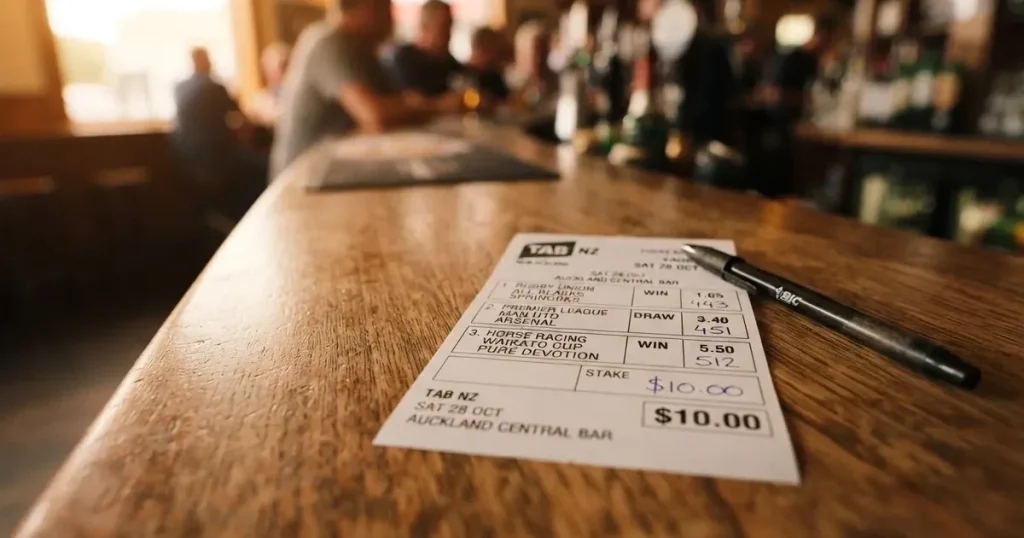
A multi bet is the most popular way New Zealanders add spice to a Saturday — picking the All Blacks, the Warriors, a couple of legs from English Premier League and a Melbourne Cup runner, then watching five results come in one by one. The appeal is obvious: small stake, bigger return. The mechanics, though, are where the price of that excitement lives. This guide breaks down how multis work, what they cost and where you can actually place one in New Zealand now that the law has changed.
As of October 30, 2026, all licensing and market data is verified against the New Zealand Gambling Commission register and TAB NZ’s published terms.
Staying in Control: Safer Gambling Comes Before the Bet
A multi bet can lose in an instant. Five legs, one losing selection, stake gone. The arithmetic behind that is simple; the cost of forgetting it is not. Before any punter works through the menu, the safer-gambling tools must already be set.

TAB NZ’s app, Racing & Sports Betting, carries deposit limits, time-outs and self-exclusion as standard settings. Set the deposit limit first — it is the most useful tool because it stops the next impulse at the door, not after the bet has been placed. Time-outs work as a short cooling-off period; self-exclusion is the heavier lever, blocking account access across both TAB and Betcha for the chosen period. None of these is a sign of weakness. They are the gear that keeps the hobby a hobby.
Outside the app, the free Gambling Helpline (0800 654 655) and text line 8006 run twenty-four hours. Safer Gambling Aotearoa provides counselling and practical support, and a punter in trouble can self-refer without going through the bookmaker. These services exist because the law and the operator both know that some percentage of every betting market is played by people who must not be playing at all.
The legal position helps frame this. Since 28 June 2025, section 74AAA of the Racing Industry Act 2020 names TAB NZ as the only provider lawfully allowed to offer racing and sports betting to people in New Zealand. The Department of Internal Affairs enforces that prohibition and told unlicensed providers to withdraw. Because there is only one lawful operator, the safer-gambling regime that comes with it is the one that reaches a Kiwi punter. Offshore brands operate outside that framework. Their self-exclusion and limit tools, where they exist, do not bind in New Zealand, and there is no complaints route to bring them back into line.
Set the limits before the first bet. That is the practical order.
Bonuses, Free Bets and the True Cost of “Free”
Bookmaker marketing calls them bonus bets, free bets, boosted odds, insurance. The word “free” does a lot of work in those phrases, and most of it is misleading.

A TAB NZ bonus bet is a promotion: place a qualifying bet, receive a bonus bet if the conditions are met. The condition is what makes the word “free” do a lot less than it seems. Common conditions include a minimum odds requirement on the qualifying bet (often $1.50 or higher in decimal form), a stake limit in the bonus period, a cap on winnings from the bonus bet, and a deadline by which the bonus must be used. None of these is a problem in itself. The problem is treating the offer as if the conditions were not there.
What does the bonus actually cost? Consider a $50 bonus bet on a multi at decimal odds 5.00. The return is $250 if it wins, but the $50 stake is not paid back with a free bet — only the profit lands. The real value depends on the punter’s selection skill: place it on something with a true probability of winning of around 20%, and the expected value of the bonus is roughly $50 minus the bookmaker’s margin baked into the price. Now subtract the turnover required to earn the bonus in the first place. The net is rarely the headline number.
Offshore brands market more aggressively. Crypto sportsbooks in particular push large welcome packages and ongoing reload bonuses. They are not illegal for the punter under section 19(4) of the Gambling Act 2003 — the law targets the operator, not the player — but they are unlawful for the operator to offer to a person in New Zealand. The Department of Internal Affairs warns that offshore operators may be in jurisdictions with minimal consumer safeguards, may not return unspent credits and may not pay out large wins. A bonus that promises the world and pays in a currency the punter cannot easily verify is not a bargain.
The move is the same each time. Read the terms: minimum odds, expiry, stake cap, withdrawal rules. Compare what the bonus is worth against the conditions. If the conditions take more betting than the bonus pays for, walk away.
Predictions, Tips and the Myth of Certain Knowledge
Multi bet tips, best multi predictions, sure things — the search results fill with pages promising a winning slip. Read them with a cold eye.
A tipster’s record is the only figure that matters, and most tipster pages do not publish one. A claim of “80% accuracy” without a verifiable, audited stake-by-stake history is marketing copy. Even with a real record, past performance is not a guarantee: a tipster who hit 60% last season may be picking the same leagues under different conditions this season, and the market adjusts. Punters who buy tips for a multi are paying for the tipster’s skill, not for certainty. Treat the price accordingly.
The math of a multi makes the tipster’s edge harder to apply. A single bet at odds 2.00 with a 55% true probability has a positive expected value. Chain three such bets into a multi and the probability of all three winning drops to about 16.6% — a number that has to clear the bookmaker’s margin baked into each leg. The margin compounds across the multi: a 5% margin per leg means the combined book on a five-leg multi is roughly 23%, not 5%. A tipster whose edge is real but small struggles to overcome that.
The practical advice: use tips as one input among many, never as a substitute for doing the work. Form, conditions, head-to-head, line-up news — the data that informs a single bet informs a multi leg the same way. The difference is that a multi demands the same standard across every leg, and the cost of one weak selection is the whole slip. Some punters cap their multi size for that reason. Three or four well-researched legs beat seven guesses every time.
Forecast services, model-based predictions, AI-generated tips: each carries the same constraint. No model knows an outcome. The punter’s job is to find the one with the smallest margin of error and bet within it, not to bet on every number it outputs.
Bet Types, Odds and How a Multi Is Built
A multi bet, also called an accumulator, parlay, acca or combo, is a single wager that links two or more selections. Every leg must win for the bet to pay out. One losing leg loses the whole stake.
The payout is the product of the decimal odds. Three selections at odds 1.50, 2.00 and 2.50 return $7.50 for every $1 staked — a $10 multi returns $75. That is the gross payout, including the original $10 stake. The calculation is straightforward, which is part of the appeal: a punter can work out the return before the bet is placed and decide whether the risk is worth it.
Push rules matter. A leg that ties — a push, in the jargon — is removed from the multi and the odds recalculate on the remaining selections. A three-leg multi at combined odds 12.00, with one push, settles as a two-leg multi at the combined odds of the two winning legs. The stake is not lost on a push, but the headline price drops.
Same-game multis, called SGMs, take all legs from one event. The All Blacks to win, the total points to be over 45.5, and a first tryscorer — all from the same match. SGMs are popular because they let the punter build a narrative around one game rather than tracking five separate results. The trade-off is correlation: the legs are linked, and a bookmaker’s pricing model accounts for that. A same-game multi at headline odds 8.00 may have a true combined probability that gives the bookmaker a larger margin than a regular multi of similar price.
Full cover bets extend the multi into multiple combinations. A Trixie on three selections covers four bets: three doubles and one treble. A Yankee on four selections covers eleven bets. A Heinz on six selections runs to fifty-seven bets, and a Super Heinz on seven selections runs to one hundred and twenty. Each structure costs more in total stake but provides insurance: a single losing selection does not wipe the bet out, because the doubles and singles that do not depend on the loser still pay. The punter trades headline odds for resilience.
The bookmaker’s margin is the silent partner in every multi. A market with a 5% margin on singles has a compounded margin on multis — roughly the sum of the per-leg margins minus their product, but the practical effect is that the bigger the multi, the larger the house edge baked into the price. A two-leg multi at fair odds of 4.00 might be priced at 3.80; a six-leg multi at fair odds of 64.00 might be priced at 50.00. The longer the slip, the more the margin eats.
The punter’s best tool is the calculator. Before placing, multiply the decimal odds of each leg, then mentally shave 5–10% for the margin. That adjusted number is closer to the true price. If the offered price is below the adjusted number, the multi is worse than fair. If above, it may be worth a small stake.
The New Zealand Betting Landscape: Who Can Actually Take Your Bet
New Zealand’s betting market is not a competitive field. It is a monopoly with two brand names.
TAB and Betcha are the two online brands of TAB NZ. Since 28 June 2025, section 74AAA of the Racing Industry Act 2020 names TAB NZ as the only provider lawfully allowed to offer racing and sports betting to people in New Zealand. There is no licence to apply for, no licence register for bookmakers, and no second lawful operator. The Department of Internal Affairs told unlicensed providers to withdraw with immediate effect.
TAB NZ runs the betting business under a 25-year partnership with Entain, signed in 2023. Entain operates the platform and shares gross profits 50/50 with TAB NZ, with at least $150 million a year going to TAB NZ for the first five years. Entain also paid a one-off $100 million to the racing sector as part of the deal. The two brands, TAB and Betcha, are not rivals; they are two front doors to the same product.
Other bookmakers — Telbet, BetAlright, BigClash, BillyBets, Spinbara, Rabona, Roobet, FunBet and others — are accessible from New Zealand through the open internet. None holds a New Zealand licence, because no such licence exists for another provider. They operate under Curaçao or other offshore frameworks that do not authorise them to take bets from people in New Zealand. The Department of Internal Affairs warns that these operators may be in jurisdictions with minimal consumer safeguards, may not return unspent credits and may not pay out large wins. There is no New Zealand complaints route and no harm-minimisation framework that reaches them.
The table below summarises who can take a bet from a New Zealand punter, and on what footing.
| Brand | New Zealand status | Betting rules and key terms |
|---|---|---|
| TAB | One of two online brands of TAB NZ; the only lawful provider of racing and sports betting in New Zealand under section 74AAA of the Racing Industry Act 2020 | Fixed-odds and tote (pool) bets; published betting rules cover Win, Place, Each Way, Quinella, Exacta, Trifecta, First Four, Double, Treble, Daily Double, Running Double, Quaddie, Big6, Multis and Same Game Multis |
| Betcha | One of two online brands of TAB NZ; the only lawful provider of racing and sports betting in New Zealand under section 74AAA | Same betting rules as TAB, with a daily Toolbox of odds boosts and insurance tools, a Bet Social section for sharing bets and pools, and a Playbook with tips and analysis |
| Telbet | Not licensed in New Zealand; an offshore brand with no authorisation to take bets from people in New Zealand | Crypto-focused sportsbook and casino; no New Zealand harm-minimisation tools and no local complaints route |
| BetAlright | Not licensed in New Zealand; an offshore brand with no authorisation to take bets from people in New Zealand | 18+ only; no New Zealand harm-minimisation tools and no local complaints route |
| BigClash | Not licensed in New Zealand; operates under a Curaçao licence that does not authorise New Zealand customers | Pre-match and live sports betting, plus virtual sports and esports; no New Zealand complaints route |
| BillyBets | Not licensed in New Zealand; an offshore brand with no authorisation to take bets from people in New Zealand | Three odds formats offered: decimal, American and fractional; no New Zealand complaints route |
| Spinbara | Not licensed in New Zealand; an offshore brand with no authorisation to take bets from people in New Zealand | Standard welcome bonus structure on its English site; no New Zealand complaints route |
| Rabona | Not licensed in New Zealand; operates under a Curaçao licence that does not authorise New Zealand customers | Sportsbook launched in December 2019 as part of the Soft2Bet group; no New Zealand complaints route |
| Roobet | Not licensed in New Zealand; operates under a Curaçao licence held by Raw Entertainment B.V. that does not authorise New Zealand customers | Crypto casino and sportsbook; no New Zealand complaints route |
| FunBet | Not licensed in New Zealand; an offshore brand with no authorisation to take bets from people in New Zealand | Sportsbook with live betting; no New Zealand complaints route |
The practical implication is stark. A punter who wants the New Zealand harm-minimisation framework — deposit limits enforced, self-exclusion that binds, complaints that go somewhere — uses TAB or Betcha. A punter who uses an offshore brand gives up that framework and takes the operator’s word on payouts, limits and dispute resolution.
The TAB NZ Monopoly in Practice
The monopoly is not theoretical. It shapes what can be bet on, how the price is set and what happens if a dispute arises.
TAB NZ accepts bets on thoroughbred, harness and greyhound racing — though greyhound racing is closing in stages from 1 August 2026, and offshore operators will not be permitted to take bets on greyhound races from that date either. The sports catalogue covers rugby (All Blacks, Super Rugby Pacific), league (NRL, Warriors), cricket (Black Caps), football, basketball, tennis and a long tail of international events. The Melbourne Cup runs every spring; the Cup Day sweep is a national tradition.
Pricing sits inside TAB NZ’s published margin. A two-leg multi at decimal odds 4.00 on fair probabilities will price closer to 3.80 once the margin is applied. The bigger the multi, the larger the margin’s bite. Same-game multis carry an additional correlation adjustment that further reduces the offered price. None of this is hidden; it is the standard bookmaker practice, and the punter who understands it prices their own bets more accurately.
If something goes wrong — a settled bet disputed, a payout delayed, a bonus bet refused — the punter has a route. TAB NZ’s customer service, then the Department of Internal Affairs, then the courts. The framework is the same one that applies to any consumer transaction in New Zealand, and it is the reason the monopoly, narrow as it is, carries a safety net the offshore market does not.
The advertising rules apply to the monopoly too. The Advertising Standards Authority’s Gambling Advertising Code prohibits ads that target under-18s, encourage harm or mislead. TAB NZ’s “bonus bets” promotions are subject to the same code. No New Zealand-specific rule caps the size of a bonus bet or the wagering terms attached to one, so the conditions are whatever TAB NZ publishes. Read them.
The tax treatment for the punter is simple. Recreational gambling winnings are generally not taxable in New Zealand, and prize money from TAB horse, dog and trotting races is exempt. A punter who bets as a business — running a betting operation as a trade — is a different case and must consult Inland Revenue or an accountant. The general rule, though, is that the punter keeps what they win.
What the Monopoly Does Not Cover
The law carves out a gap. Online casino gambling is a separate regime, and the Online Casino Gambling Act 2026 licenses online casinos only. It does not license sports betting. TAB NZ has won the right to apply for an online casino licence, but that extension does not change the sports-betting monopoly. A punter who wants a casino product is in a different regulatory space, with its own licence register and its own harm-minimisation rules, and the rest of this guide does not apply to it.
Spread betting and betting exchanges are not part of the TAB NZ offering. No lawful New Zealand betting exchange exists. Bets on politics and novelty markets are not established under TAB NZ’s published rules. Virtual sports, meaning computer-simulated events, are treated as casino gambling under the 2026 law. Esports sit in a grey area — whether they count as “sports betting” under the Racing Industry Act is not established. The punter who wants to bet on an event not listed in the TAB NZ catalogue finds no lawful route inside New Zealand.
The offshore brands fill those gaps — politics, novelty, esports, virtual sports, casino-sports hybrids — and that is part of why they attract New Zealand traffic. The trade-off, as the table above makes plain, is the loss of the New Zealand harm-minimisation framework and the consumer protections that come with it.
Choosing a Bookmaker: A Practical Checklist
A punter comparing options works through the same questions, whatever the market.
Is the operator licensed to take bets from New Zealand residents? If the answer is no — and for every brand other than TAB and Betcha, it is no — the punter accepts the trade-off outlined above. Offshore brands are accessible but operate outside the New Zealand framework.
What does the margin look like? A market with a 5% margin on singles will have a compounded margin on multis. The bigger the multi, the more the price is shaved. A punter who bets singles pays less margin per bet than a punter who bets five-leg multis, all else equal.
What do the bonus conditions actually require? Minimum odds, turnover, expiry, stake cap, withdrawal rules. A bonus that sounds generous but locks the punter into heavy turnover at minimum odds is not generous in practice. Compare the bonus amount against the expected cost of clearing it.
What are the safer-gambling tools? Deposit limits, time-outs, self-exclusion. These are the levers that keep a hobby a hobby, and the punter who skips them learns the lesson expensively.
What is the complaints route? TAB NZ routes through the Department of Internal Affairs. Offshore brands route through their own customer service, then their own regulator (often Curaçao, which is not known for fast enforcement). The punter who chooses offshore accepts the weaker route.
What does the punter’s own bankroll look like? Multi bets are high-variance. A punter with a small bankroll is better served by singles at carefully chosen prices, or by small-stake multis with two or three legs. A punter with a large bankroll can absorb the variance of longer multis, but still faces the compounded margin.
Reviewed Bookmakers in the New Zealand Market
The brands below are presented for comparison, not as a recommendation. TAB and Betcha are the only lawful options; the others operate outside New Zealand’s regulatory framework. The punter who reads these write-ups is comparing what each offers, knowing that the legal status is fixed and the choice is between the safety net and the wider menu.
TAB — The Default Choice for Most Kiwi Punters
TAB is the original New Zealand bookmaker, the retail outlet on every main street and the tote behind every race. It is one of two online brands of TAB NZ, the only provider lawfully allowed to offer racing and sports betting to people in New Zealand under section 74AAA of the Racing Industry Act 2020.
The catalogue is broad: thoroughbred, harness and greyhound racing (greyhounds closing from 1 August 2026), plus rugby, league, cricket, football, basketball, tennis and a long tail of international sports. The betting rules cover the full set — Win, Place, Each Way, Quinella, Exacta, Trifecta, First Four, Double, Treble, Daily Double, Running Double, Quaddie, Big6, Multis and Same Game Multis. Same-game multis are a popular product, and the margin on the standard markets is competitive with the global offshore average.
The platform is operated by Entain under a 25-year partnership. Safer-gambling tools — deposit limits, time-outs, self-exclusion — are built into the app. The self-exclusion applies across TAB and Betcha. Bonus bet promotions run regularly, and the conditions are published in plain terms. The age requirement is 18; account opening needs a verified New Zealand address and ID.
For the punter who wants the New Zealand framework behind their bet, TAB is the default. The trade-off is the monopoly price: no rival is pushing TAB NZ’s margin down through competition. A punter who believes the margin is too high has no lawful alternative.
Betcha — The Same Product, a Younger Wrapper
Betcha is the second online brand of TAB NZ, sharing the same betting rules, the same Entain-operated platform and the same monopoly position. The difference is presentation. Betcha is positioned for a younger, more social punter, with a daily Toolbox of odds boosts and insurance tools, a Bet Social section where punters chat and follow tipsters, and a Playbook with tips and match analysis.
The catalogue and the rules are identical to TAB’s. The safer-gambling tools are the same. The self-exclusion binds across both brands. A punter who self-excludes at TAB is self-excluded at Betcha, and vice versa.
The choice between TAB and Betcha is a choice of interface, not of product. A punter who likes the traditional tote and the wide market depth uses TAB. A punter who wants the social feed and the daily boosts uses Betcha. Neither is the cheaper option, because both sit on the same margin.
Offshore Brands — What They Offer, What They Cost
The brands below are accessible from New Zealand through the open internet. None is licensed to take bets from New Zealand residents. Each carries a Curaçao or other offshore licence that authorises it to operate in its home jurisdiction, not in New Zealand. The Department of Internal Affairs warns that these operators may be in jurisdictions with minimal consumer safeguards, may not return unspent credits and may not pay out large wins. A punter who uses them accepts that warning.
Telbet is a crypto casino and sportsbook. The welcome offer is a percentage match plus free spins and a small free bet, denominated in Bitcoin and USDT. The multi-bet product is standard, with margin applied across the legs. The risk is the usual offshore one: a dispute over a payout goes to Telbet’s customer service first, then to Curaçao if it escalates, and Curaçao is not known for fast enforcement. A punter who values the New Zealand framework must not be here.
BetAlright accepts customers over 18 and operates a standard sportsbook with multi-bet capability. The terms are operator-level, and the safer-gambling tools are whatever the site publishes. There is no New Zealand complaints route. The brand runs a separate partners site, but the core question for a Kiwi punter is the same: no New Zealand licence, no New Zealand framework, no recourse through the Department of Internal Affairs.
BigClash offers pre-match and live sports betting across international and local leagues, plus virtual sports and esports. The Curaçao licence (8048/JAZ) gives no authority to take bets from people in New Zealand. The catalogue is broad, which is part of the draw, but the trade-off is the same: no local protection if a payout stalls or a bonus bet is disputed.
BillyBets offers three odds formats (decimal, American and fractional) and a standard sportsbook. The multi-bet product is conventional, and the margin follows the offshore market average. No New Zealand licence, no local complaints route.
Spinbara advertises welcome bonuses on its English site — a first-deposit casino match and a sportsbook match in fiat and crypto. The product is standard, the licence is offshore, and the New Zealand framework does not reach it.
Rabona launched in December 2019 as the sixth sportsbook of the Soft2Bet group. The multi-bet product is conventional, and the catalogue covers the major sports. The Curaçao licence gives no authority in New Zealand, and the punter who bets here is outside the New Zealand consumer protection regime.
Roobet is a crypto casino and sportsbook operated by Raw Entertainment B.V. under a Curaçao licence (OGL/2024/687/0427). The crypto focus is the draw; the lack of New Zealand authorisation is the cost. A punter who values the New Zealand framework must not be here.
FunBet offers a sportsbook with live betting and a 24/7 bookmaker. The multi-bet product is standard, and the catalogue covers football, ice hockey, American football, basketball, volleyball, tennis, rugby and baseball. No New Zealand licence, no local complaints route.
The verdict on the offshore set is the same across the board. They offer a wider catalogue, more aggressive bonuses and crypto-friendly banking. They offer none of the New Zealand harm-minimisation framework, no recourse through the Department of Internal Affairs and no guarantee that a disputed payout will be resolved. A punter who chooses one of them is making a conscious trade-off, and the trade-off must be made with eyes open.
The Payout Calculation: What a Multi Actually Returns
A multi’s payout is the product of the decimal odds of each leg. For a three-leg multi at odds 1.50, 2.00 and 2.50 with a $10 stake, the calculation runs:
Return = stake × (odds₁ × odds₂ × odds₃)
Return = $10 × (1.50 × 2.00 × 2.50)
Return = $10 × 7.50
Return = $75
That is the total returned to the punter, including the $10 stake. The net profit is $65. A four-leg multi at the same per-leg odds can return $10 × 18.75 = $187.50, with a net profit of $177.50. A five-leg multi at the same per-leg odds can return $10 × 46.875 = $468.75, with a net profit of $458.75.
The pattern is clear: each additional leg multiplies the return. The risk multiplies too. A three-leg multi with a 60% win probability per leg has a 21.6% chance of all three winning. A five-leg multi at the same per-leg probability has a 7.8% chance. A seven-leg multi drops to 2.8%. The compounded margin from the bookmaker reduces the effective probability further.
The practical band for a punter is two to four legs. Two legs gives a meaningful boost over a single without demanding every selection to be a near-cert. Three legs is the standard “weekend multi” length. Four legs stretches the probability but still allows each leg to be carefully priced. Beyond four, the compounded margin and the compounded variance push the bet into lottery territory, and the expected value tends to be negative even for skilled punters.
The arithmetic is simple. The discipline is choosing where to stop.
Frequently Asked Questions
How are multi bets calculated?
A multi bet’s payout is calculated by multiplying the decimal odds of each leg together, then multiplying the result by the stake. For a three-leg multi at odds 1.50, 2.00 and 2.50 with a $10 stake, the return is $10 × 7.50 = $75, including the original stake. If any leg loses, the entire stake is lost; if a leg ties (a push), it is removed and the odds recalculate on the remaining legs.
How do multi bets work?
A multi bet links two or more selections into a single wager. Every leg must win for the bet to pay out. The odds multiply together, so a $10 stake on three legs at combined odds 7.50 returns $75 if all three win. The bookmaker’s margin is baked into each leg’s price, and the longer the multi, the larger the compounded margin the punter pays. Same-game multis take all legs from one event.
What is a multi bet and how does a same-game multi differ from it?
A multi bet links two or more selections from different events into one wager; every leg must win. A same-game multi (SGM) takes all of its legs from a single event, such as the All Blacks to win, total points over 45.5 and a first tryscorer. SGMs allow a narrative bet on one game, but the legs are correlated, and the bookmaker’s pricing accounts for that, often resulting in a higher margin than a standard multi of similar headline price.
How is the return on a bet worked out from the stake and the odds?
For a single bet, the return is the stake multiplied by the decimal odds. A $10 bet at odds 2.50 returns $25, including the $10 stake; the net profit is $15. For a multi, the combined odds are the product of the per-leg odds, and the return is the stake multiplied by that combined figure. The formula holds whether the bet is a two-leg multi or a seven-leg multi.
How are decimal odds such as 2.10 turned into a return?
Decimal odds already represent the total return per unit staked, including the original stake. Odds of 2.10 mean a $1 stake returns $2.10, with $1.10 net profit. A $50 stake at 2.10 returns $105. To convert decimal odds to a break-even probability, divide 1 by the decimal odds: 1 ÷ 2.10 = 47.6%. A bet only has positive expected value if the true probability of winning is higher than that break-even figure.
Tips & strategy – kiwibettingbonuses
Content created by the «kiwibettingbonuses» team
